Why Your Ritual Needs a Shorter Version Before It Needs a Better One
Quick Answer: Rituals fail at the point where the full version becomes impossible, and without a shorter version, impossible means skipped. A skipped day breaks the chain, the chain was the thing holding the ritual together, and the redesign that follows produces another all-or-nothing routine with the same failure point. The durable move is not a better ritual - it is a two-minute version of the one you have, defined in advance, that counts as a complete day.
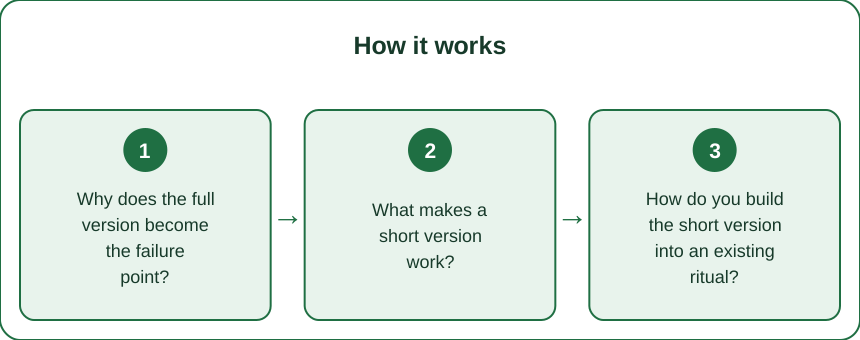
Here is why the short version does more work than the full one, and how to build it.

Why does the full version become the failure point?
Because a ritual’s survival depends on frequency, and frequency depends on the worst days rather than the best ones.
Habits form through repetition in a consistent context. The relevant variable is how often the behaviour occurs in the same setting - not how well it is performed. A twenty-minute morning practice done four times a week is a weaker habit signal than a three-minute one done seven times, even though it involves far more total time.
A full-length ritual has multiple failure conditions. It needs time, energy, a quiet space, and often equipment or preparation. Any one of those going missing takes the whole thing down, and across a month, at least one of them goes missing regularly.
The all-or-nothing structure converts a small obstacle into a total skip. Fifteen minutes short of the time needed produces zero minutes done rather than a reduced version, because there was no reduced version to reach for.
And the skip is more costly than the missed session. The behaviour was tied to a self-concept - someone who does this every morning. One skip contradicts the self-concept, and the second skip is substantially easier than the first because the streak’s protective value is already gone.
This is why rituals collapse suddenly rather than gradually. They run perfectly for six weeks and then stop within four days. The full version was never the fragile part - the absence of an alternative was.
What makes a short version work?
It has to satisfy three conditions, and most people’s version of a shortened ritual satisfies only one.
It must be genuinely trivial. Two or three minutes, no preparation, no equipment. If it requires any negotiation on a bad day, it is too long - and the test is whether you would do it while ill, travelling, or running late.
It must be defined in advance and fixed. Not decide in the moment how much to do - that is a judgement call, and judgement calls on tired days resolve as no. A specific, unchanging minimum removes the decision entirely.
It must count as a complete day. This is the condition people get wrong. If the short version feels like a partial failure, it does not protect the self-concept and it does not protect the chain. The short version has to be an unqualified yes, not a compromise.
It should preserve the ritual’s core element, not a fraction of everything. If the ritual is a morning practice of movement, breathing, and journalling, the short version is one of those done properly - not ninety seconds of all three. Fractions of everything feel like a diminished version; one element done fully feels complete.
And it should live in the same context as the full version. Same place, same trigger, same point in the day. The context is what carries the habit, and moving the short version to a different time or place breaks the association the ritual runs on.
A useful check: the short version should feel almost silly on a good day. That reaction means it is small enough to survive a bad one.
How do you build the short version into an existing ritual?
Retrofitting is straightforward, and the sequencing matters.
Start by identifying the core. Which single element, if removed, would make the ritual stop being what it is? That is the short version. Everything else is enhancement.
Define it in concrete terms with a time or a count. Three minutes of breathing. One page. Five movements. Vague definitions - a bit of stretching - fail because they require interpretation at exactly the moment interpretation is expensive.
Practise the short version deliberately while things are going well. This is counterintuitive and it is the step that makes it work. Use it once a week on a normal day, so it is an established behaviour rather than an emergency improvisation. A fallback you have never used is not a fallback.
Record both versions the same way. If you track the ritual, the short version marks the day complete with no asterisk. Any distinction in the record reintroduces the failure it exists to prevent.
And keep the full version as the default rather than the target. The short version is not the plan - it is the floor beneath the plan. On ordinary days you do the full thing; the floor exists so ordinary bad days do not become breaks.
One caution: if the short version becomes your daily default for several weeks, that is information rather than failure. It usually means the full version is mis-sized for your current life - and the correct response is to formally shrink the full version rather than to keep failing to reach it.

What happens when a ritual collapses anyway?
It will, periodically, and the recovery method matters more than the prevention.
Restart at the short version, not the full one. The instinct after a break is to return at full strength to compensate. That reproduces the original fragility immediately and typically produces a second collapse within a fortnight.
Do not reschedule it to a new time. Rebuilding in the original context is far easier than establishing a new one, because the environmental cues are already associated with the behaviour. A ritual that ran at 7am for months has infrastructure at 7am.
Restart on an ordinary day rather than waiting for a Monday. Waiting for a natural restart point adds days of not doing it, and each additional day weakens the association further. Wednesday afternoon is a fine time to restart a morning ritual - you simply begin the following morning.
Expect the second run to establish faster than the first. The cues, the context, and the sequence are already learned. Rebuilding is genuinely quicker than building, which is the most encouraging thing about a collapse.
And treat repeated collapses at the same point as design feedback. If the ritual dies every time you travel, it needs a travel version. If it dies whenever someone else is home, it needs a version that works with company. The pattern is telling you which condition the design does not accommodate, and that is more useful than more discipline.
Seasonal collapse is its own category worth planning for. Morning rituals frequently fail as the mornings get darker - the same 6am is a different experience in August and October, and a ritual that depended on early light needs an adjusted version rather than more willpower when the clocks change.
What Nobody Tells You About Rituals
Consistency and quality trade off, and consistency wins over any timescale that matters. A modest practice done daily for a year vastly outperforms an excellent one done sporadically. This is obvious in principle and almost universally ignored in practice, because designing an impressive ritual is more enjoyable than doing an unimpressive one.
The ritual is not the behaviour - it is the context. The place, the time, the sequence, the cup, the specific chair. Change enough of the context and the ritual stops working even with identical content, which is why routines fall apart on holiday, after moving house, or when a housemate’s schedule changes.
Adding to a working ritual is riskier than it feels. A stable morning routine that gains a fourth element frequently becomes unstable, because you have raised the completion cost of the whole thing. Add slowly, and be willing to remove.
Rituals with a social component are more durable but less flexible - harder to skip and harder to shorten. The best structure is often a private core with an optional social layer, so the durable part does not depend on anyone else’s schedule.
A ritual that requires equipment fails wherever the equipment is not. Anything that needs a specific mat, machine, or app has a built-in geography, and travel is where those rituals die.
And the one that surprises people: the most successful long-term ritual keepers are frequently doing something noticeably less impressive than what they started with. They shrank the ritual until it survived, rather than continually restarting an ambitious one. The unimpressive version that has run for three years is the actual achievement.
This is general information, not medical advice. If a routine is tied to managing a health condition, or if you find that missing it produces significant distress, that is worth discussing with a healthcare professional rather than treating as a habit design problem.
FAQ: Ritual and Routine Questions, Answered
How short should my minimum version be?
Two or three minutes, with no preparation or equipment. If you would hesitate to do it while ill, travelling, or running late, it is still too long.
Does doing the short version count as keeping the streak?
Yes - and it has to, or it does not work. If the short version registers as a partial failure, it cannot protect the consistency it exists to protect.
What if I end up doing the short version most days?
That is useful information rather than failure. It usually means the full version is mis-sized for your current life, and the right response is to formally shrink the full version.
Should I restart a collapsed ritual at full strength?
No. Restart at the minimum version, in the original time and place. Returning at full strength reproduces the fragility that caused the collapse.
Why do my routines fall apart when I travel?
Because a ritual is largely context - place, time, sequence, and objects. Rituals that need specific equipment or a specific room have a built-in geography, and travel removes it.
Is it better to add to a working routine or start a separate one?
Usually separate, or add very slowly. Each addition raises the completion cost of the whole ritual, which is how stable routines quietly become fragile ones.
TL;DR:
- Rituals fail where the full version becomes impossible, and without a shorter version, impossible means skipped.
- Habit strength tracks frequency in a consistent context, not quality - three minutes daily beats twenty minutes four times a week.
- The short version must be trivial, defined in advance, and count as a complete day with no asterisk.
- Preserve one core element done properly, not a fraction of everything - fractions feel like failure, one element feels complete.
- Practise the short version on good days so it is an established behaviour rather than an emergency improvisation.
- After a collapse: restart at the minimum, in the original time and place, on an ordinary day - not at full strength next Monday.
- Repeated collapse at the same point is design feedback: it needs a travel version, a company version, or a darker-mornings version.
The unimpressive version that has run for three years is the achievement.
This is general information, not medical advice.
Keep Reading
This article is for general informational and styling purposes only. Fit, sizing, and product availability may vary.