The Complete Guide to Rebuilding Your Rituals After Starting a New Job
Quick Answer: Rituals do not live in your intentions; they live attached to anchors — a commute, a start time, a room, a colleague, a quiet hour. A new job replaces all of those simultaneously, so habits that felt permanent collapse together in week two or three. The rebuild is not about discipline. It is about finding the new anchors first, waiting until the shape of the job is clear, and reattaching a small number of rituals deliberately rather than trying to restore the old set.
Most people try to keep their old routine and fail, then conclude they have become undisciplined.
The routine was fine. Its anchors are gone.

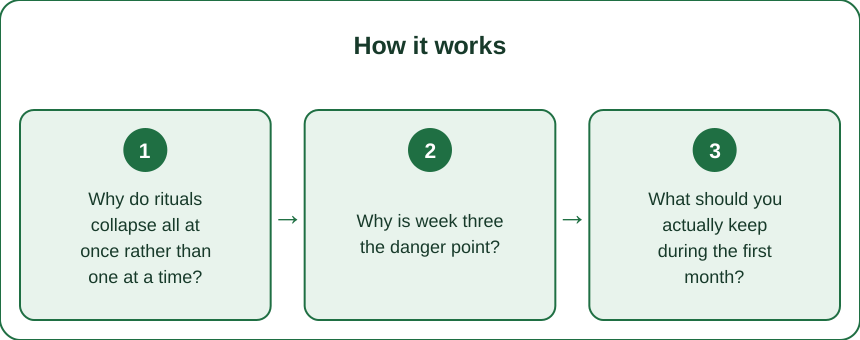
Why do rituals collapse all at once rather than one at a time?
Because they were all attached to the same small set of anchors.
A habit that feels self-sustaining is almost always attached to something structural. Your morning walk was attached to leaving the house at 7:40. Your evening reading was attached to getting home at six. Your Sunday reset was attached to knowing what Monday looked like.
When one anchor moves, one ritual wobbles. When you start a new job, every anchor moves in the same week: a different start time, a different commute, a different lunch arrangement, different colleagues, a different level of end-of-day tiredness, and — most disruptive of all — an unpredictable schedule while you learn what the job actually involves.
So they do not fail one by one. They fail together, in a cluster, usually somewhere between week two and week four once the initial adrenaline of a new role has worn off.
This is worth naming clearly, because the experience from the inside feels like a personal failure. It is not. It is the completely predictable result of removing the structure that a set of behaviours was resting on. Any ritual attached to an anchor that no longer exists was going to stop, regardless of how committed you were to it.
Why is week three the danger point?
Because that is when novelty stops carrying you and the new structure has not formed yet.
The first week of a new job runs on adrenaline and attention. Everything is interesting, you are alert, and the disruption to your routines feels temporary and acceptable. You tell yourself you will get back to normal once you have settled in.
By week three, the novelty has worn off, the cognitive load of learning a new role is at its peak, and you are genuinely tired — but the schedule is still not stable enough to build on. You have neither the energy of week one nor the structure of month three.
This is where people typically try to force the old routine back and fail, which then adds a sense of failure on top of the fatigue. It is also where the most damaging conclusions get drawn: I am not the kind of person who keeps a routine any more, or this job is not compatible with looking after myself.
Neither is usually true. What is true is that week three is the worst possible moment to attempt a rebuild — you have maximum load and minimum information. Anything constructed then is built on a schedule that does not yet exist. The better move is to accept a deliberately minimal period and rebuild once you can actually see the shape of the week.
What should you actually keep during the first month?
One thing. Possibly two.
The instinct is to protect everything, and the result is that everything gets done badly and then abandoned. The more effective approach is to choose a single keystone ritual and let the rest go temporarily, explicitly and without guilt.
Choosing well matters. The keystone should be:
- Short. Under fifteen minutes, so it survives a bad day
- Attached to something that has not changed — waking up, showering, getting into bed. These anchors survive a job change; the commute does not
- The one that most affects everything else. For most people that is sleep timing, a short morning movement, or a genuine wind-down
- Not dependent on other people or on a specific location
What to let go, explicitly:
- Anything attached to the old commute
- Anything requiring a predictable finish time
- Anything social that needs coordination
- Anything over thirty minutes
The key word is explicitly. A ritual you have consciously paused for a month is a decision. The same ritual quietly not happening is a failure, and the difference between those two framings determines whether you come back to it. Write down what you are pausing and when you will revisit it — around week five is a reasonable date.

How do you find the new anchors?
By observing, not by planning, for about three weeks.
You cannot design a routine around a schedule you do not yet understand. So the first job is reconnaissance, and it is genuinely productive work even though it feels like doing nothing.
Things worth noticing during the first month:
- What time do you actually leave the house? Not what time you intended to
- What is the quietest part of your working day? Every job has one, and it is rarely where you expect
- When do you get home, realistically, on a normal day rather than a good one?
- When does your energy drop? New jobs often shift this considerably
- What is genuinely fixed? A standing meeting, a school run, a train time. These are your new structural anchors
- Where are the natural transitions? The walk from the station, the first ten minutes at your desk, the moment you close the laptop
Transitions are the most valuable anchors of all, because they already exist as boundaries in your day and attaching something to them costs almost nothing. A two-minute practice attached to closing the laptop is far more durable than a thirty-minute practice scheduled for 7pm.
After three weeks you will have a genuine map. Building on that map takes an afternoon and lasts. Building on assumptions in week one takes an afternoon and lasts nine days.
How do you rebuild without over-committing?
One ritual at a time, with two weeks between additions.
The standard error is to rebuild everything on the same Sunday — new morning routine, new evening routine, new weekend structure, all starting Monday. That is four simultaneous behaviour changes in a period when your cognitive load is still elevated. The failure rate is close to total, and it burns the motivation you would have needed for a second attempt.
A workable sequence:
Weeks 1 to 3: keystone ritual only. Observe. Change nothing else.
Week 4: add one ritual, attached to an anchor you have actually verified exists. Keep it under ten minutes.
Week 6: if the week-4 addition has held, add one more.
Week 8: review. Anything that has not held by now needs a different anchor, not more effort.
Two further principles worth applying throughout. First, a shorter ritual outlasts a better one — a five-minute version that happens is worth more than a twenty-minute version that does not, and you can always extend later. Second, attach rather than schedule. A ritual attached to an existing behaviour (after I put my bag down, before I open my laptop) is considerably more durable than one attached to a clock time, because the clock does not care whether your day ran late.
Expect to end up with fewer rituals than you had before, at least initially. That is not a loss. A new job takes real capacity, and three rituals that hold are better than seven that flicker.
Myth vs Fact: Rebuilding Routines After a Job Change
Myth: If a habit was strong enough, it would survive a job change
Fact: Habit strength is largely about the reliability of the cue. Change the cue and even a years-old habit loses its trigger. This says nothing about your discipline and everything about how habits are structured.
Myth: You should rebuild everything at once so the disruption is over quickly
Fact: Simultaneous behaviour changes compete for the same limited self-regulation capacity, and a new job is already consuming most of it. Sequential rebuilding is slower on paper and dramatically more likely to survive.
Myth: The first week is the hardest
Fact: The first week is usually the easiest, because novelty carries you. Week three is where routines actually die, and knowing that in advance is most of the defence.
Myth: A new job means you need a completely new routine
Fact: Usually you need the same rituals attached to different anchors. The content rarely needs to change; the attachment point almost always does.
Myth: Once things settle down you will naturally get back to normal
Fact: Nothing returns on its own, because the anchors it was attached to no longer exist. Rituals have to be deliberately reattached, and once things settle down is the phrase under which most of them quietly disappear for good.
FAQ: New Job Ritual Questions, Answered
How long before my schedule is stable enough to build on?
For most roles, four to six weeks. Jobs with shift patterns or heavy travel take longer — sometimes a full quarter — and in those cases you build around the fixed points that exist in every version of the week rather than around a typical day.
What if I have already lost everything and it has been three months?
Start with one ritual, attached to an anchor that genuinely exists now. Do not try to restore the old set — most of it was attached to a life you no longer have. Three months in you have excellent information about your actual schedule, which makes this an easier rebuild than week three, not a harder one.
Should I tell people at work about my routines?
For anything that affects your availability — a lunchtime walk, a hard finish time on certain days — yes, and early. Establishing it in the first two months is far easier than introducing it in month six, when expectations have already formed.
Is it worth keeping a ritual that no longer fits?
Rarely. If a ritual only worked because of the old commute or the old office, holding onto it out of loyalty just generates repeated small failures. Keep the function — movement, quiet, transition — and let the specific form change.
What about weekend rituals?
They are usually the most durable, because weekends change least with a job change. They are also the ones people abandon first, on the grounds of catching up. Protecting one weekend ritual through the transition gives you a fixed point in a month where nothing else is fixed.
This is general information, not clinical advice. If a job transition is affecting your sleep or mood substantially and persistently, that is worth raising with a doctor.
TL;DR:
- Rituals live attached to anchors — commutes, start times, quiet hours — and a new job removes all of them at once
- They collapse together in week two or three, when novelty fades and structure has not formed
- Keep one short keystone ritual attached to something that has not changed, and pause the rest explicitly
- Spend three weeks observing your real schedule before rebuilding anything
- Add one ritual at a time, two weeks apart, attached to transitions rather than clock times
- A shorter ritual that happens beats a better one that does not
If your routines fell apart when you changed jobs, nothing went wrong with you. The scaffolding they were resting on was replaced overnight, and scaffolding has to be rebuilt before anything can stand on it again. Give it three weeks of watching, then put one thing back.
This is general information, not clinical advice.
Keep Reading
This article is for general informational and styling purposes only. Fit, sizing, and product availability may vary.