Why Your Ritual Collapses the Moment Someone Else Is Home
Quick Answer: Most rituals are not built on time or willpower — they are built on uninterrupted attention. When someone else is in the house, the attention disappears before the time does, which is why a routine that ran flawlessly for six weeks alone can fall apart in two days of company. The fix is to design rituals that need privacy of attention rather than privacy of space: shorter anchors, portable versions, and a stated start signal other people can see.
You know the pattern. You spend a month building something that finally sticks — twenty minutes with coffee and a notebook, or a stretch sequence before the day starts. It survives bad sleep. It survives a busy week. Then your partner works from home for three days, or a friend stays over, or the kids are off school, and by Thursday it is simply gone.
The usual explanation is that you got busy. That is almost never what happened. The clock did not change. What changed is that the twenty minutes stopped being yours in a way your nervous system recognizes.
This is one of the least discussed reasons routines fail, and it explains why so many people conclude they are bad at consistency when what they are actually bad at is defending attention in a shared room.

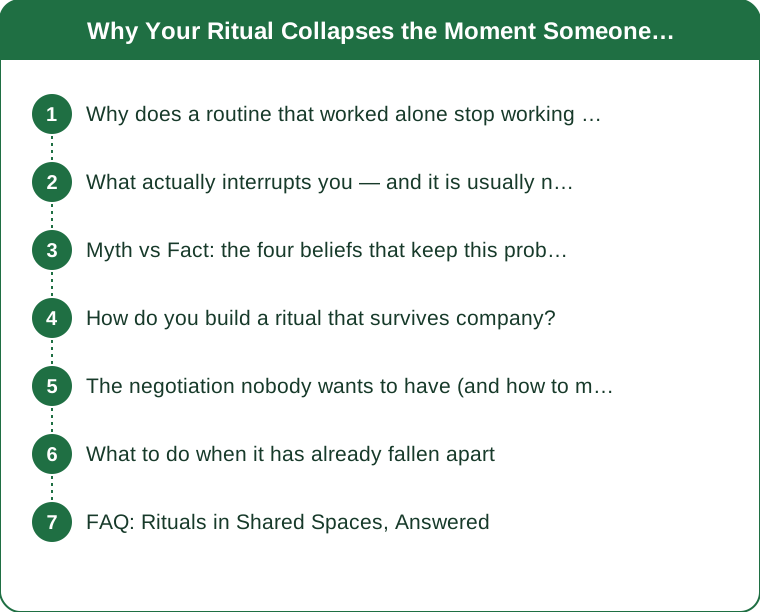
Why does a routine that worked alone stop working with people around?
Because solitude does more work in a ritual than anyone gives it credit for.
When you are alone, your attention has nowhere to go. There is no one who might speak, no footsteps to track, no half-conscious monitoring of what someone else needs. Your brain settles into the task because there is no competing signal. That settling is the actual mechanism of the ritual — not the tea, not the notebook, not the stretch sequence.
Add one person to the space and a background process starts running. Researchers who study attention call this a form of divided monitoring: even when the other person is not interacting with you, part of your processing stays allocated to them. You are not being oversensitive. You are doing what humans have always done in the presence of other humans.
The result is that the same twenty minutes delivers maybe eight minutes of the settled state you built the habit for. And because the habit was reinforced by how that state felt, the reward drops. Two or three low-reward repetitions in a row and the behavior stops being automatic.
This is why it feels like the ritual stopped working rather than like you stopped doing it. From the inside, that is exactly what happened. You did the steps and got very little back.
Understanding this changes what you do next. If you think the problem is discipline, you will try to force the same ritual through the interruption and fail again. If you understand the problem is attention, you can redesign for the conditions you actually live in.
What actually interrupts you — and it is usually not conversation
When people list what breaks their morning, they name conversation. In practice conversation is the smallest part of it.
The bigger disruptors are anticipatory. You are waiting for the interruption more than you are being interrupted. If your partner usually comes downstairs around 7:15, your 7:00 ritual is already compromised at 7:02, because some part of you is counting down. Nothing has happened yet and the quality is already gone.
The second disruptor is transition noise: a shower running, a door, a kettle, drawers. These are not loud enough to be annoying, which is exactly why they work — they are just informative enough to pull orientation. Your brain checks each one against a model of what is happening in the house.
Third is what you might call obligation proximity. When another person is awake and in the same room, doing something purely for yourself has a small social cost, even if nobody has said a word. Most people unconsciously shorten or hurry a personal ritual when observed, and hurrying is the fastest way to strip the state out of it.
Notice that none of these three are solvable by asking someone to be quiet. They are solvable by changing when, where, or how the ritual runs.
A useful diagnostic: on a day the ritual felt hollow, ask whether you were interrupted or whether you were merely available to be interrupted. If it is the second one — and it usually is — you have an anticipation problem, not a noise problem.
Myth vs Fact: the four beliefs that keep this problem unsolved
Myth: I just need to wake up earlier than everyone else. Fact: This works until the day it does not, and it makes the ritual dependent on the single most fragile variable in your life — sleep. It also tends to produce a routine you can only do in one 30-minute window, which is the opposite of resilient. Waking earlier is a fine option. Building your only option on it is not.
Myth: A real habit should survive any conditions. Fact: Habits are context-bound by definition. The research on habit formation is consistent on this point: cues are environmental, and when the environment changes the cue often stops firing. A routine that breaks in a changed context is behaving exactly as habits behave, not failing morally.
Myth: I should be able to tune other people out. Fact: Some people can, most cannot, and the ability varies by day, by stress level, and by relationship. Building a plan that requires you to be the version of yourself who can tune out a spouse making breakfast is planning around a person who shows up maybe twice a week.
Myth: If I explain that I need this time, the problem is solved. Fact: Explaining helps a great deal, and it is worth doing. But it addresses interruption, not anticipation or obligation proximity. People routinely ask for space, receive it perfectly, and still find the ritual feels thinner than it did in an empty house. That surprise is what sends them back to thinking they are the problem.

How do you build a ritual that survives company?
Design for the crowded version first, then let the quiet version be a bonus.
Shorten the anchor to something absurdly small. The core of the ritual should take three to five minutes, not twenty. A three-minute anchor can be completed inside the gap before anyone comes downstairs, and it can be completed with a person in the room without the hurry penalty, because three minutes does not feel like claiming territory. Whatever else you do that morning is expansion, not requirement.
Give it a visible start signal. A specific mug, a lit candle, headphones on, a particular chair. This solves obligation proximity better than any conversation, because it converts an invisible internal state into an object other people can read. Most household members will route around a visible signal automatically once they learn what it means.
Build a portable version. If the kitchen version needs the kitchen empty, you need a second location — a car before you go in, a step outside, a bathroom, a corner of a bedroom. Same anchor, different room. Habits attached to two contexts are dramatically more durable than habits attached to one.
Decouple from a clock time. Instead of 7:00, use after I start the coffee or before I open my laptop. Sequence-based cues survive schedule chaos; clock cues do not.
Name the interruption rule in advance. Decide now what happens if you get pulled away at minute two: you resume, you cut to the last step, or you take the three-minute version and call it complete. Deciding in advance stops the interruption from becoming a decision about whether the whole thing counts.
The negotiation nobody wants to have (and how to make it small)
There is a conversation people avoid here because it feels like asking for something unreasonable, and the avoidance costs them the routine.
Make it concrete and small. Do not say I need morning time to myself. Say something closer to: for the first ten minutes after I come downstairs, I am going to be quiet with my coffee — nothing is wrong, and I will be normal after that. Two sentences, a specific duration, and an explicit reassurance that the silence is not about the other person.
That last part matters more than people expect. Much of the friction in shared-space rituals comes from the other person reading quiet as mood. Once quiet is labeled in advance, it stops requiring interpretation, and you stop half-monitoring how it is being read.
If you live with children, the same principle applies with different mechanics. Duration-based requests do not work well; visible signals and sequence rules work better. A closed door with a specific object on the handle. A rule that the ritual runs while a particular show is on. Something a five-year-old can verify without asking you.
For guests and temporary disruptions, drop to the three-minute portable version deliberately and tell yourself that is the plan. A ritual you intentionally scaled down stays intact. A ritual you skipped while telling yourself you would get back to it tomorrow is the one that does not come back — the streak breaks psychologically, not practically.
What to do when it has already fallen apart
Assume it will fall apart periodically and have a restart procedure, because the restart is the actual skill.
Do not restart at full size. The most common mistake is coming out of a disrupted week and attempting the original twenty-minute version on day one. It usually fails, and the second failure carries more weight than the first, because now the story is that you cannot keep anything going.
Restart at the three-minute anchor for four consecutive days regardless of how it feels. Four days is roughly the point where the sequence cue reattaches for most people. Expand only after those four.
Change one variable, not all of them. If the ritual collapsed under company, alter the location or the length — not the content. People tend to rebuild with an entirely new routine, which throws away the reinforcement they had already built.
Track the condition, not the streak. Note next to each day whether you were alone or not. After two weeks you will have real data on which version of the routine survives which conditions, and that data is more useful than any advice, including this article. Some people discover the shared-house version is fine and the problem was a single recurring 7:15 event. Others discover the ritual only ever worked alone, in which case the portable second location is the whole solution.
The goal is not a routine that never breaks. It is a routine with a known, unheroic path back.
FAQ: Rituals in Shared Spaces, Answered
Is it selfish to want a routine other people have to work around?
No, and framing it that way is what keeps people from asking. A ten-minute request with a clear end time is one of the smallest asks in a shared household. Most resistance people imagine never actually materializes — the request usually lands as unremarkable.
Should I just do my ritual at night instead?
Possibly, but test it rather than assuming. Evening rituals face the opposite problem: fatigue and accumulated obligations rather than anticipation. Some people find evenings far more protected because everyone else is settled. Run it for a week before switching permanently.
How long until a shared-space version feels normal?
Roughly two to three weeks of consistent repetition for the new cue to fire on its own, and it feels awkward for the first four or five days — particularly the visible start signal, which most people report feeling self-conscious about at first and then stop noticing entirely.
TL;DR:
- Rituals run on uninterrupted attention, not on time — which is why company breaks them even when nobody interrupts you.
- Anticipating an interruption costs more than the interruption itself; obligation proximity makes you hurry when observed.
- Build the crowded version first: a three-to-five-minute anchor, a visible start signal, a portable second location, and sequence-based cues instead of clock times.
- Ask for a specific, small, labeled window rather than time to yourself in the abstract.
- When it collapses, restart at the small version for four days before expanding, and change only one variable.
The routine you built in an empty house was never really about the house — it was about having your attention to yourself for a few minutes. Once you design for that directly, the number of people in the kitchen stops deciding whether the day starts well.
Keep Reading
This article is for general informational and styling purposes only. Fit, sizing, and product availability may vary.