The Third Space: Rituals That End Work Before Home Begins
The commute, for all its faults, did one job well: it gave work-you ten or twenty quiet minutes to decompress into home-you before you walked through the door. Remote work deleted that buffer, and now the two selves collide at a laptop lid instead. A work-to-home transition ritual is how you rebuild that missing third space — a deliberate, ten-minute sequence that actually ends the workday instead of letting it bleed into dinner.
Quick Answer: A work-to-home transition ritual is a short, repeatable sequence — writing tomorrow’s top priorities, physically closing the laptop, and doing a brief physical activity like a walk or a change of clothes — that signals to your brain the workday is genuinely over. It replaces the psychological function the commute used to serve.

What should a work shutdown ritual actually include?
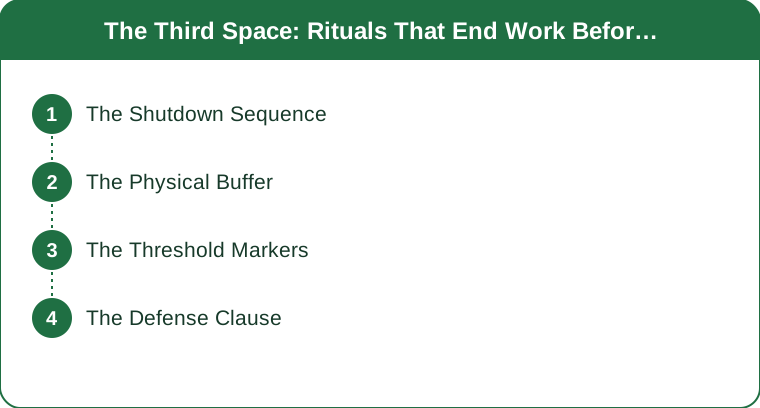
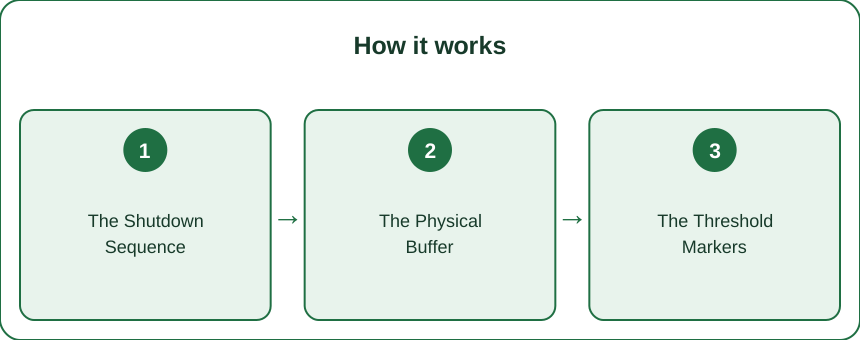
A short written sequence closes open mental loops before they can reopen at dinner. Write down tomorrow’s top three priorities so your brain has somewhere to file unfinished business instead of replaying it all evening. Give your inbox one last look, then close the laptop fully — and ideally put it out of sight, not just to sleep on the coffee table where you’ll glance at it twice an hour.
The whole sequence takes maybe five minutes, and it tells your brain what the commute used to: the shift is over.

Why does a physical activity matter more than a mental one?
Your body’s state change drags your mind’s state change along with it — so a “fake commute” works surprisingly well. A ten-minute walk around the block that ends with you “arriving” home, a few minutes on the balcony with a drink, or simply changing out of work clothes into loungewear all do the same job: they give your nervous system a physical cue that matches the mental one.
A few versions that people actually stick with:
- The walk-around-the-block — literally recreate a short commute, even from a home office.
- The clothes-change ritual — work clothes off means work-self off; loungewear becomes the uniform of the evening shift.
- The balcony or porch pause — a few minutes of fresh air with a coffee or a drink before you step back inside.

What small objects or habits mark the end of the workday?
Sensory switches do boundary-setting work that words alone can’t. An evening playlist that only plays after six, a candle lit at the same time every day, or the phone dropped into an overnight tray all function as small, repeated signals rather than one-off decisions you have to remember to make. A candle isn’t just decor here — it’s a border checkpoint with a scent attached to it.
These threshold markers work precisely because they’re small and boring; a ritual you have to think hard about is a ritual you’ll skip on a bad day.
How do you protect a shutdown ritual once you’ve built it?
The ritual survives on defense as much as on habit. The “just one last email” impulse is the ritual’s biggest threat — it reopens every loop the sequence just closed, and it’s rarely actually urgent. A household agreement that transition minutes are genuinely off-limits (not “I’ll just be a second”) keeps the buffer real instead of theoretical.
Ten guarded, protected minutes buys back an entire evening’s presence — the old commute charged you forty for the same result, and it wasn’t even optional.
5 Mistakes Everyone Makes With Work-Home Transitions
- Skipping the ritual on “just a quick day” — those are exactly the days the boundary matters most.
- Leaving the laptop open “just in case” — visibility alone keeps the work-brain half-active.
- Checking “one last email” — it almost never stays at one.
- Doing the ritual mentally instead of physically — a body cue works where a thought alone doesn’t.
- Not telling your household it’s happening — an unprotected ritual gets interrupted within a week.
How long should a work-to-home transition ritual take?
Most effective rituals take five to ten minutes — long enough to include a short written wrap-up and one physical cue, short enough that you’ll actually do it every day. Longer isn’t better here; consistency matters far more than duration.
What if I work from a bedroom or small space with no separate room?
Physical cues matter even more without a separate office — a change of clothes, a specific chair you only sit in during “off” hours, or stepping outside for even two minutes can substitute for a literal room change. The ritual is doing the work a separate space would otherwise do for you.
Does a transition ritual actually reduce work stress in the evening?
Anecdotally and by design, yes — the same principle behind post-commute decompression applies here: a clear physical and mental cue that a task-mode has ended helps most people disengage faster than no cue at all. If evening anxiety persists despite a consistent ritual, it may be worth a conversation with a professional about workload or boundaries beyond just the transition itself.
TL;DR:
- Write tomorrow’s top three priorities, then fully close the laptop out of sight.
- Add one physical cue — a walk, a clothes change, or a balcony pause — to match the mental shift.
- Use small sensory markers like a candle or playlist as repeatable boundary signals.
- Guard the ritual from “one last email” and get your household to respect the minutes.
- Ten protected minutes can buy back an entire evening’s real presence.
Keep Reading
This article is for general informational and styling purposes only. Fit, sizing, and product availability may vary.