The Habit You Keep Adding Is the One Killing Your Whole Routine
Quick Answer: Routines don’t fail from lack of discipline — they fail from habit stacking past your actual capacity. A 3-step routine you do daily beats a 7-step routine you do twice a week; the fix is subtracting back to the version you actually finished this week, not adding motivation.
Three weeks ago your morning routine was tea, five minutes of stretching, done. It worked. Then you read something inspiring and added journaling. Then a gratitude list. Then a cold shower. Now the whole thing takes 40 minutes and you’ve skipped it four days running. This isn’t a motivation problem — it’s math, and the math has a specific, findable breaking point.

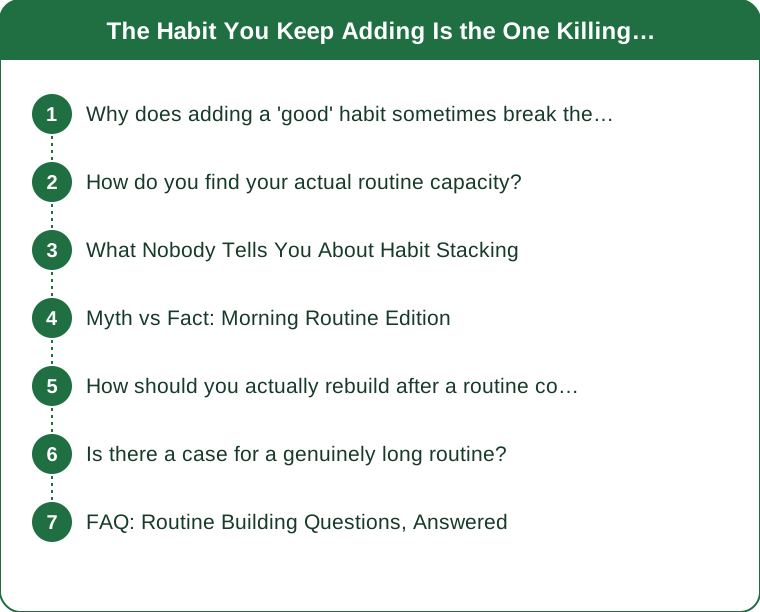
Why does adding a ‘good’ habit sometimes break the whole routine?
Because routines have a capacity ceiling — a rough daily time-and-willpower budget that doesn’t expand just because the new addition is worthwhile. Journaling is genuinely good for you. So is cold exposure. So is a gratitude list. None of that changes the fact that a 6-step routine costs roughly double the completion-willpower of a 3-step one.
The failure point is rarely the newest habit itself — it’s that the new habit pushed the total past what you reliably execute on a busy, low-motivation Tuesday, which is the day that actually determines whether a routine survives, not your best Sunday.
How do you find your actual routine capacity?
Look at your worst day in the last two weeks, not your best. What did you still manage to do, even tired, even rushed, even after a bad night’s sleep? That’s your real capacity — usually 2-4 items, rarely more.
Most people build their routine based on a well-rested Sunday morning fantasy and then wonder why Tuesday breaks it. Build from Tuesday backward instead: if tea and stretching survive a bad Tuesday, that’s your floor. Everything else is a bonus round for good days only, not a fixed requirement.
What Nobody Tells You About Habit Stacking
The advice to ‘stack habits’ — attach a new one to an existing one — is usually given without a stopping point. Nobody tells you how many stacks is too many, so people keep adding until the chain snaps, and the snap usually takes the original habit down with it, not just the new addition.
Here’s the part that surprises people: when a stacked routine collapses, it rarely reverts to the smaller working version. It usually reverts to nothing — because the routine now feels like an all-or-nothing block rather than a set of separable pieces. That’s the real cost of over-stacking: you don’t just lose the new habit, you lose the one that was already working.

Myth vs Fact: Morning Routine Edition
Myth: A longer routine means more self-improvement. Fact: A routine you complete 7/7 days at 3 items produces more compounded benefit over a month than one you complete 2/7 days at 7 items — consistency beats content almost every time.
Myth: If a routine breaks, you failed and need more discipline. Fact: If a routine breaks specifically after you added steps, that’s a capacity signal, not a character flaw. The fix is subtraction, not a pep talk.
Myth: Copying someone else’s 10-step routine will work if you’re consistent enough. Fact: Their capacity ceiling was built through years of habit, and their 10 steps were probably added one at a time over a long period, not all at once like a new copy does.
How should you actually rebuild after a routine collapses?
Don’t rebuild all 6 steps at once. Go back to the last version that survived a real bad-day test, then re-add slowly:
- Week 1: run only the version that worked before (probably 2-3 items)
- Week 3: if that’s held solid for 2 full weeks including at least one rough day, add exactly one new item
- Week 5+: repeat, one addition per 2-week solid streak, never two at once
This feels frustratingly slow compared to redesigning the ‘perfect’ routine in one sitting. It’s also the version that’s still running in 6 months, which the perfect version usually isn’t.
Is there a case for a genuinely long routine?
Yes — for people whose mornings are unusually low-obligation (no kids, flexible start time, high and stable energy). But even then, the long routine tends to be the product of years of one-at-a-time additions, not something adopted whole from a wellness influencer’s post.
If you’re rebuilding from scratch, assume you’re not that person yet, regardless of how motivated you feel this week specifically. Motivation is the least reliable predictor of which habits survive a bad Tuesday three months from now.
FAQ: Routine Building Questions, Answered
How many habits should a morning routine actually have?
Most sustainable routines land at 2-4 core items. More than that usually requires either an unusually low-obligation life stage or years of gradual buildup — not a fresh start.
Should I feel bad about cutting steps from my routine?
No — cutting back to what you actually complete consistently is the fix, not a failure. A routine’s job is to run, not to look impressive on paper.
What’s the fastest way to tell if a routine will survive long-term?
Run it through one deliberately bad day — short on sleep, running late, low motivation. If it survives that day mostly intact, it’ll likely survive the month. If it doesn’t, it’s over capacity.
TL;DR:
- Routines break from exceeding your real capacity, not from lack of willpower
- Build from your worst recent day, not your best — that’s your true floor
- Add one habit at a time, only after 2 solid weeks including a rough day
- A shorter routine you finish daily beats a longer one you finish twice a week
Tonight, cut your routine back to the version that survived your worst day this month — you can always add back, slowly, from there.
Keep Reading
This article is for general informational and styling purposes only. Fit, sizing, and product availability may vary.