The Complete Guide to Running Separate Weekday and Weekend Rituals
Quick Answer: A single routine applied to structurally different days will fail on the days it fits worst — almost always the weekend. The fix isn’t more discipline; it’s designing two explicit versions that share an anchor and differ in everything else. Two designed routines hold up dramatically better than one universal one applied inconsistently.
Your weekday mornings run themselves. Then Saturday arrives, the whole sequence evaporates, and by Tuesday you’re rebuilding from scratch — the third week in a row. That isn’t a willpower failure. It’s what happens when you apply one design to two genuinely different sets of constraints.

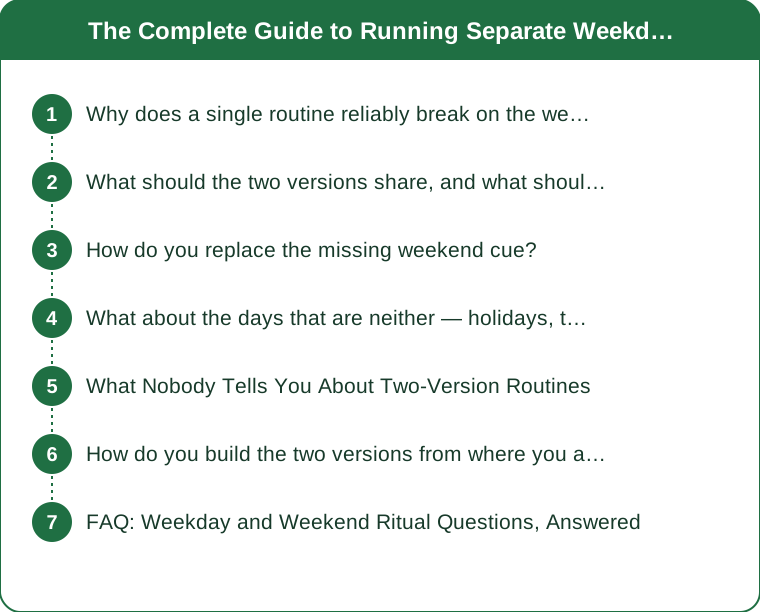
Why does a single routine reliably break on the weekend?
Because the weekday version is held together by things that only exist on weekdays, and most people never notice which parts were doing the work.
The cues disappear. A weekday routine is usually chained to a fixed wake time, a commute, or a first meeting. Those are external forcing functions, and they carry far more of the routine than the internal motivation does. Remove them and the sequence has nothing to hang on.
The purpose changes. A weekday morning routine is mostly preparation — getting into a state for work. On Saturday there’s nothing to prepare for, so a preparation ritual feels faintly absurd, and people abandon it while telling themselves they’re being lazy.
The time available inverts. Weekdays are time-poor and structure-rich. Weekends are the reverse. A tight 20-minute weekday sequence dropped into an open Saturday morning either happens at a random hour or dissolves entirely.
What the collapse actually costs
The cost isn’t the two missed days. It’s the restart friction. A habit interrupted every weekend never accumulates the repetitions that make it automatic, which means you’re perpetually in the effortful phase. Running the same routine for eight months without ever getting past that phase is a common and demoralizing experience, and it has a structural cause rather than a personal one.
This is also why people conclude they’re ‘bad at routines’ when what’s actually happened is that they’ve been running a two-day reset loop for months. The evidence looks like personal failure and is really a design flaw.
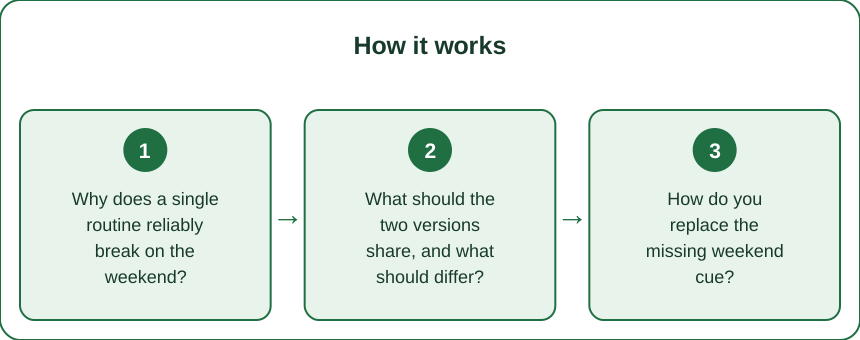
What should the two versions share, and what should differ?
The rule that makes this work: share one anchor, vary everything else.
The anchor is a single small action that happens in both versions, at roughly the same point in the sequence, regardless of the day. Not the whole routine — one piece. Drinking a full glass of water before anything else. Ten minutes of reading before opening a screen. Making the bed. Stepping outside for two minutes.
The anchor does two jobs. It preserves identity continuity — you’re still a person who does this thing, every day, which matters more psychologically than the specific content. And it gives the weekend version something to build around, so it isn’t starting cold.
What should differ: duration, sequence, intensity, and purpose. The weekday version can be efficient and preparatory. The weekend version should be slower, longer where you want it longer, and oriented toward something other than readiness.
A worked example
Weekday: water → 10 minutes of stretching → shower → coffee while reading news → out the door. Total 45 minutes, fixed at 6:30.
Weekend: water → coffee made slowly → 30 minutes reading a book → a longer walk → breakfast that involves cooking. Total 2 hours, floating anywhere between 7:30 and 9:30.
The only overlap is the glass of water. Both are recognizably the same person’s morning, and neither is pretending to be the other. Notice too that the weekend version isn’t the weekday one stretched out — it has different content, because it’s doing a different job.
How do you replace the missing weekend cue?
This is the technical core of the whole problem. Weekday routines run on external cues; weekend routines need a substitute, and most people never install one.
Time-based cues fail on weekends. Setting an alarm for the same time Saturday works for about two weeks and then loses to a late Friday night. Building on a fixed weekend wake time is building on sand.
Event-based cues work better. Instead of at 8am, use when I first come downstairs or after I feed the cat or once I’ve opened the curtains. These happen whenever you get up, which makes them robust to a variable wake time — the single biggest weekend variable.
Location cues are the strongest available. Doing the weekend ritual in a specific place — a particular chair, the porch, one end of the kitchen counter — creates a physical trigger that doesn’t depend on the clock at all. Walking into that space becomes the cue.
Sequence cues chain reliably. Each element triggers the next: water triggers coffee, coffee triggers sitting in the chair, sitting in the chair triggers reading. You only need to initiate the first link.
The specific trap
Don’t make the weekend cue contingent on something that varies. After my morning run fails on the Saturdays you don’t run, and then the rest of the sequence goes with it. Anchor to something that happens every single weekend day without exception, however trivial.

What about the days that are neither — holidays, travel, sick days?
You need a third version, and it should be almost insultingly small.
Call it the minimum version: the anchor alone, and nothing else. Glass of water. Two minutes outside. That’s the whole routine on a travel day, a sick day, a holiday, or a day that’s fallen apart by 9am.
Why this matters more than it sounds: the minimum version prevents the all-or-nothing collapse that turns one disrupted day into a disrupted fortnight. Someone who does the two-minute version on a bad day resumes the full routine the next day easily. Someone who skips entirely faces a restart, and restarts are where routines go to die.
Define it in advance, in writing. The minimum version has to be decided when you’re thinking clearly, not improvised at 7am in a hotel room. Improvised minimums are always zero.
Applying it during transitions
Late summer into fall is one of the year’s genuine routine-disruption windows — school schedules restart, daylight shifts, travel clusters around the last warm weeks. This is exactly when the minimum version earns its place. Expect the next six weeks to include several days where it’s all you manage, and treat that as the system working rather than failing.
What Nobody Tells You About Two-Version Routines
The weekend version is harder to design and matters more. Everyone puts their effort into the weekday routine because that’s where the productivity pressure sits. But the weekday version has structural support holding it up; the weekend one has none, so it needs better design. Most people design them in exactly the wrong proportion.
Two versions feel like cheating at first. There’s a strong instinct that a real routine should be identical every day, and that varying it is a compromise. It isn’t — matching a routine to genuinely different conditions is what makes it survivable. The identical-every-day version is the fantasy.
You’ll want to make the weekend version productive. Resist this hard. The moment the weekend routine acquires goals, it becomes a second work shift and you’ll start avoiding it. Its job is different by design.
The transition days are the real problem. Friday and Monday are where the two versions collide, and both tend to be sloppy. Deciding explicitly which version Friday morning uses — usually the weekday one — removes a surprising amount of low-grade friction.
Three weeks is the honest evaluation window. Two-version routines feel worse than single ones for about the first two weeks, because you’re maintaining two things instead of one. The payoff shows up around week three, when the weekend stops breaking the chain and repetitions start actually accumulating.
How do you build the two versions from where you are now?
A four-week sequence that works better than redesigning everything at once.
Week 1 — observe without changing. Note what you actually do on Saturday and Sunday mornings. Not what you intend; what happens. Most people discover the weekend already has a shape, just an unexamined one, and building on that existing shape is far easier than imposing a new one.
Week 2 — pick the anchor and install it in both. One action, both versions, every day. Nothing else changes. If your weekday routine already has a natural first move, use that.
Week 3 — design the weekend version deliberately. Write it down. Choose its cue — event or location, not time. Keep it to three or four elements; ambitious weekend routines fail at the same rate as ambitious weekday ones.
Week 4 — define the minimum version and stress-test. Deliberately run the minimum on one ordinary day, so you’ve practiced it before you need it under pressure.
Signs it’s working
Monday no longer feels like a restart. The weekend version happens without deliberation by about week five. And the anchor becomes genuinely automatic — which is the point at which the whole structure stops requiring management, and starts running on its own.
FAQ: Weekday and Weekend Ritual Questions, Answered
Won’t two routines be twice as hard to maintain?
For about two weeks, yes. After that it’s easier, because neither version is fighting conditions it wasn’t built for. The maintenance cost of a routine that breaks weekly is much higher than it looks.
What if I work weekends or shifts?
The principle holds; the labels change. Build a work-day version and an off-day version, defined by day type rather than by calendar. Shift workers often benefit more from this approach than anyone.
Should evening routines get the same treatment?
Yes, and the effect is often stronger. Evening routines are more exposed to social plans, which vary far more by day type than mornings do.
How small should the anchor be?
Small enough that skipping it would be strange. If you can imagine a plausible day where the anchor doesn’t happen, it’s too big.
What if the weekend version keeps drifting later?
That’s usually fine, as long as it still happens. Drift only matters if it pushes the routine past the point where it fits into the day at all — anchor it to an event rather than a clock and the drift stops mattering.
TL;DR:
- One routine applied to structurally different days breaks on the days it fits worst
- Share a single small anchor across both versions; vary duration, sequence, and purpose
- Weekday routines run on external cues — weekend versions need event or location cues instead
- Define a minimum version in advance for travel, illness, and days that fall apart
- Expect two weeks of extra friction before the payoff appears around week three
The routine you keep isn’t the one with the best design on paper. It’s the one that survived last Saturday. Building for that day specifically, rather than hoping it behaves like a Tuesday, is most of the work.
Keep Reading
This article is for general informational and styling purposes only. Fit, sizing, and product availability may vary.