The Complete Guide to Rebuilding a Ritual You Have Already Abandoned Twice
Quick Answer: A third attempt fails for a different reason than the first two, and copying the original plan is what guarantees a fourth. Start by identifying the exact point of collapse in the previous attempts - almost always a specific day, place or competing demand rather than a general loss of motivation. Then rebuild at roughly a third of the original size, attached to an event that already happens reliably, with a defined minimum version. The advantage of a third attempt is information; the risk is repeating a design you have already disproved twice.
You know exactly how this routine goes because you have watched it end twice.
That is not a discouraging fact. It is the most useful data you have, and almost nobody uses it.

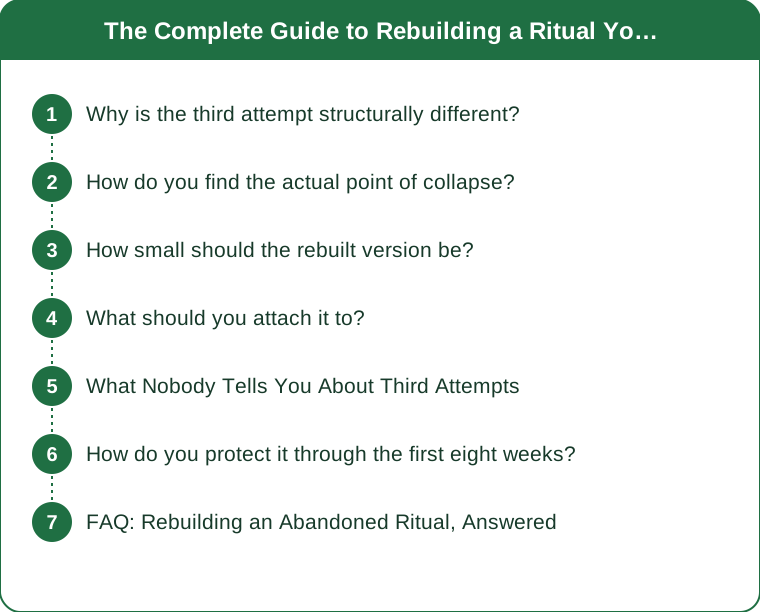
Why is the third attempt structurally different?
You now have evidence, which the first attempt did not. Two failures contain a precise record of where the design breaks, and that record is more valuable than any general advice about habit formation.
But you also carry an expectation of failure, which changes the cost of a missed day. On a first attempt a missed day is a missed day; on a third it reads as confirmation, and that reading is what converts one skip into an ending.
Self-efficacy - your belief that you can do the thing - is a well-documented predictor of whether behaviour change sticks, and it takes damage from repeated attempts at the same plan. Which means the third attempt has to produce early, visible success more urgently than the first did.
That is an argument for a much smaller plan, not a more disciplined one. A third attempt that is obviously achievable rebuilds the belief; an ambitious one that fails again removes what remains of it.
The two failures also usually share a cause. Almost nobody’s routine collapses randomly - it collapses at a specific point, and the point tends to repeat.
Which makes the first task diagnostic rather than motivational. Before deciding what the new routine is, you need to know precisely what killed the last one.
And there is a real advantage here that first-timers do not have: you know your actual failure mode, which is the single hardest thing to learn about your own behaviour.
How do you find the actual point of collapse?
Write down the last day you did the routine on both previous attempts. Not approximately - the specific day, or as close as you can reconstruct it.
Then write what was different about that week. Travel, a deadline, a house guest, illness, a schedule change, a season change, someone else being home.
Look for the overlap between the two attempts. In most cases there is one, and it is specific: the routine collapsed both times in the week the mornings got dark, or both times when work travel started, or both times when a partner’s schedule changed.
Distinguish the trigger from the drift. The trigger is the week it stopped; the drift is the two weeks afterwards where you did not restart. These need separate solutions - the trigger needs a contingency plan, the drift needs a restart rule.
Notice which part of the routine went first. Routines with several components usually shed one before collapsing entirely, and that component was carrying more cost than it looked.
Check whether the routine ever depended on someone else’s cooperation, which is one of the most common hidden fragilities and almost never appears in the original plan.
And be specific about time of day. A morning routine that failed twice in the same week of the year usually failed on daylight, and a routine that failed on busy evenings failed on competition for the same hours.
This exercise takes about fifteen minutes and it is the difference between a third attempt and a repeat of the first.
How small should the rebuilt version be?
Roughly a third of the original. If the abandoned routine was thirty minutes, rebuild at ten.
Keep only the component you actually missed. Most abandoned routines had one element that produced the value and three that produced the length - and after two failures you know which is which.
Define a minimum version that takes under two minutes, and treat it as fully counting. Not a reduced version, not a compromise - a legitimate completion.
The two-minute floor exists for disrupted days, and it is what prevents the drift phase, which is what actually ends routines.
Resist adding back components for at least six weeks, which is longer than feels necessary and shorter than the time you have already lost to two collapses.
Expect the small version to feel insufficient. It is supposed to. The goal of the third attempt is not the routine’s benefits - it is producing an unbroken stretch long enough that the routine stops feeling provisional.
And write down what the full version and the minimum version are, because deciding in the moment on a bad day is what produces skips.
A ten-minute routine done for eight weeks beats a thirty-minute routine done for nine days, and that comparison is the entire argument.

What should you attach it to?
An event that already happens reliably, not a clock time. After the kettle boils, after you close the laptop, after the school drop-off, before you get in the shower.
Test the anchor against your worst week, not your best. An anchor that only exists on calm days is not an anchor.
Choose an anchor that survives other people being home, which is where a large share of routines quietly die - particularly evening ones.
Physical location helps more than most people expect. A specific chair, a specific corner, a specific side of the kitchen makes the routine easier to start than a specific time does.
Prepare the physical setup the night before if the routine needs anything - the mat out, the notebook open, the kettle filled. The setup is frequently the real barrier rather than the routine.
Avoid stacking it onto another habit you are also rebuilding, since a chain is only as reliable as its weakest link and two fragile habits together are worse than either alone.
And pick an anchor that exists on weekends too, or explicitly write a separate weekend version. Weekend collapse is one of the most common failure modes and it is almost always an anchor problem - the weekday anchor simply does not occur.
If you cannot find a reliable anchor, that is the finding, and it means the routine needs a different time of day rather than more effort.
What Nobody Tells You About Third Attempts
The routine you abandoned twice may not be the routine you want. Two collapses at the same point sometimes mean the design was wrong; sometimes they mean you never actually wanted this specific practice and adopted it because someone else described its benefits convincingly. It is worth asking honestly before rebuilding, because a routine you are performing out of obligation has a very short shelf life regardless of design.
Copying someone else’s routine is the most common origin of a twice-abandoned one. Routines that fit their owner’s schedule, chronotype, household and season rarely transfer intact, and the parts that do not fit are exactly the parts that break first.
Missing one day is statistically almost irrelevant to whether a habit forms. The research on this is reassuring: single lapses do not meaningfully derail habit formation. What derails it is the interpretation of the lapse, which on a third attempt is much harsher than on a first.
A written restart rule is worth more than a longer routine. Decide now, in advance: if I miss two days, I do the two-minute version on day three, no negotiation. That sentence prevents the drift phase that has ended this routine twice already.
Habit formation timelines vary enormously between people and behaviours - the commonly cited averages hide a range running from weeks to many months. If your routine has not felt automatic after a month, that is unremarkable rather than evidence of a problem.
Seasonal timing is a real variable and it is rarely accounted for. Morning routines built in June are built on 5am daylight, and they meet a completely different environment in October. If both previous attempts died in autumn, the routine needs a winter version rather than more commitment.
Telling one specific person - not a group, not the internet - measurably changes follow-through for many people, and it costs nothing. A single person who will ask about it once a week is a surprisingly strong support.
And the third attempt genuinely does have better odds than the first two, provided it is not the same plan. The information you gained from two failures is real; the only way to waste it is to rebuild the same design and hope.
How do you protect it through the first eight weeks?
Track completion only, in the crudest possible way. A mark on a calendar. Not duration, not quality, not how it felt.
Review at two weeks, not at the end. The purpose is to catch a bad anchor early, while adjusting is cheap.
Expect week two to be the hardest, since novelty has gone and results have not arrived. This is the most commonly reported drop-off point across behaviour change generally.
Plan the known disruption before it arrives. If you have travel or a busy stretch coming in week four, write the minimum version for those days now, while you are calm.
Do not increase the routine because it feels easy. Easy is the goal state for the first two months - the temptation to expand at week three is a well-worn route back to the same collapse.
Keep the setup visible. The notebook on the table, the mat unrolled, the kettle prepared. Visual cues do a disproportionate share of the work.
Watch for the first component you start skipping, since that is the early warning signal that preceded both previous collapses.
And write one sentence at week eight about what is different this time. It is the record you will want if there is ever a fourth attempt - and it is usually the point at which you notice there will not need to be.
FAQ: Rebuilding an Abandoned Ritual, Answered
Why did my routine fail twice at the same point?
Because the collapse point is usually structural - a recurring schedule conflict, a seasonal change, or another person’s routine - rather than motivational. Structural causes repeat until the design changes.
How small should the third attempt be?
About a third of the original, with a defined minimum version under two minutes. The goal of attempt three is an unbroken stretch, not the routine’s full benefits.
Does missing one day ruin habit formation?
No. Research on habit formation indicates single missed days do not meaningfully derail the process. The damage comes from how the miss is interpreted and the drift that follows.
How long until it feels automatic?
Highly variable - commonly cited averages conceal a range from a few weeks to many months depending on the behaviour and the person. A month without automaticity is normal.
Should I change the routine or the time of day?
If the collapses share a time-related cause - dark mornings, evening commitments, weekends - change the anchor before changing the content. Anchor problems masquerade as motivation problems.
What if I abandon it a third time?
Run the same diagnostic on the third failure. Three data points identify a pattern more reliably than two, and the honest conclusion is sometimes that you want a different practice rather than a better version of this one.
Is it worth telling someone?
For many people, yes - one specific person who will ask about it weekly, rather than a public announcement. It costs nothing and measurably changes follow-through.
TL;DR:
- A third attempt fails differently than a first - it needs diagnosis before design.
- Find the exact collapse point in both previous attempts; it is usually the same structural cause.
- Rebuild at roughly a third of the original size with a defined two-minute minimum version.
- Attach it to an event that happens reliably, tested against your worst week and your weekends.
- Write a restart rule in advance: two missed days means the minimum version on day three.
- Track completion only, review at two weeks, and do not expand before eight.
- Two failures are information. The only way to waste them is to rebuild the same plan.
The routine you abandoned twice does not need more discipline - it needs a different design and a much smaller starting point.
Keep Reading
This article is for general informational and styling purposes only. Fit, sizing, and product availability may vary.