How to Build Rituals That Survive Travel Instead of Falling Apart the Moment You Leave Home
Quick Answer: Rituals that survive travel are built around a small, portable core action — not a specific location, product lineup, or exact timing — so the ritual can flex to fit an unfamiliar environment instead of requiring conditions that only exist at home.
Most self-care and morning routines quietly fail the first real test they face: a hotel room, an early flight, or a schedule that isn’t yours to control — and the fix has less to do with willpower than with how the ritual was designed in the first place.

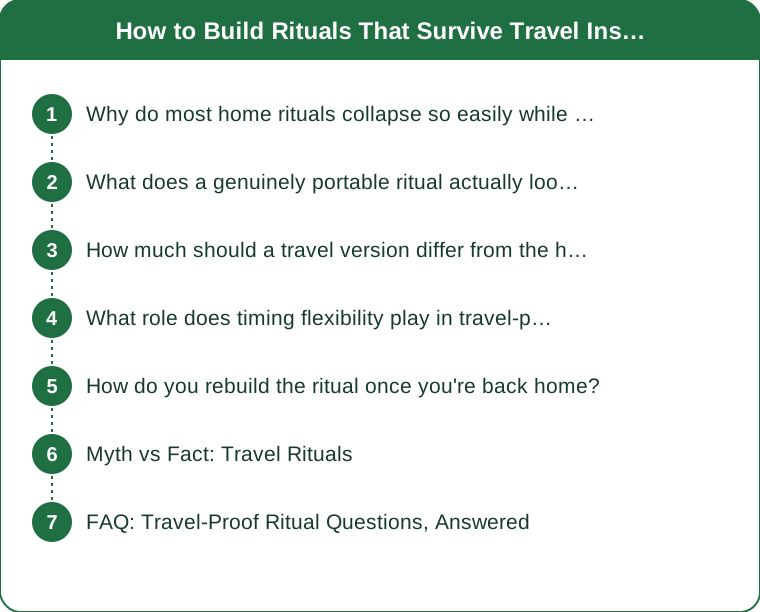
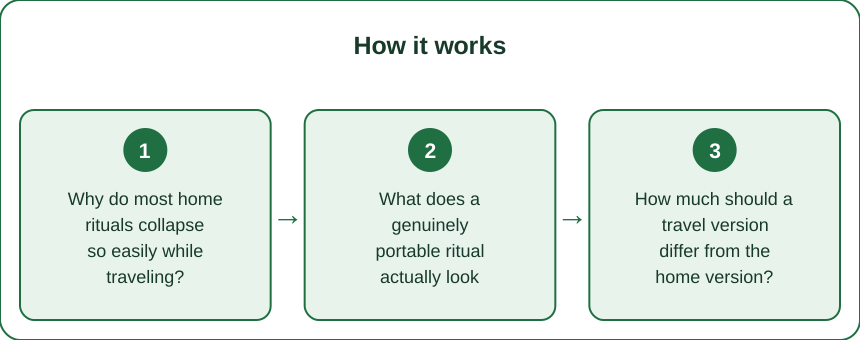
Why do most home rituals collapse so easily while traveling?
Most rituals are built around a specific environment without anyone realizing it — the same mug, the same lighting, the same quiet fifteen minutes before anyone else in the house wakes up. Travel removes nearly all of those environmental cues at once, and a ritual that depended on them rather than on a repeatable action has nothing left to hold onto.
This is why people who describe themselves as deeply committed to a morning routine often report it vanishing entirely during even a short trip — the commitment was real, but the design of the ritual made it fragile. A ritual anchored to an action rather than a setting is what survives that kind of disruption.
What does a genuinely portable ritual actually look like?
A portable ritual usually strips down to one or two core actions that require no special equipment and almost no space — five slow breaths before checking a phone, a single page of journaling, or a two-minute stretch sequence that works on a hotel room floor as easily as a bedroom.
The goal isn’t to recreate the full home version in miniature, but to identify the one or two elements that actually matter most and build the travel version around just those. A ten-step evening routine at home might become a single grounding action while traveling, and that’s a success, not a compromise.
How much should a travel version differ from the home version?
It’s reasonable, and often necessary, for a travel ritual to look meaningfully different from the home version — shorter, simpler, and less dependent on specific products or spaces. Trying to force an exact replica onto an unfamiliar environment is usually what causes people to abandon the ritual altogether rather than adapt it.
Thinking of the travel version as a deliberately scaled-down variant, built in advance rather than improvised in the moment, makes it far more likely to actually happen. Deciding what that scaled-down version looks like before a trip, rather than during one, removes a decision that’s otherwise easy to skip when time is tight.

What role does timing flexibility play in travel-proof rituals?
Home rituals are often tied to a specific time of day, but travel schedules rarely cooperate with that precision — an early flight, a packed itinerary, or a time zone shift can all push a usual ritual time out of reach. Building in flexibility about when the ritual happens, rather than rigidly defending a specific hour, keeps the ritual alive even when the schedule doesn’t match home life at all.
Some people find it helpful to reframe the ritual as something that happens once within a broad window — anytime in the first hour awake, for example — rather than at an exact clock time. That flexibility is often the single biggest factor in whether a ritual survives a disrupted schedule or quietly disappears for the duration of a trip.
How do you rebuild the ritual once you’re back home?
Returning from travel often comes with its own disruption — jet lag, a backlog of tasks, and an unfamiliar sense of being out of rhythm even in a familiar space. Rebuilding the full home version of a ritual doesn’t need to happen on day one back; easing back in over two or three days tends to stick better than trying to snap back immediately.
Some people find that keeping a piece of the simplified travel version even after returning home — the shorter, more portable core action — becomes a permanent upgrade to the ritual rather than a temporary substitute. A ritual that got tested and survived travel often comes back home more resilient than it left.
Myth vs Fact: Travel Rituals
Myth: skipping a ritual entirely while traveling is better than doing a “lesser” version. Fact: a scaled-down version that actually happens builds far more consistency over time than an all-or-nothing approach that guarantees weeks-long gaps during any travel.
Myth: a ritual isn’t real if it changes based on circumstances. Fact: the rituals that last the longest are usually the ones flexible enough to adapt to circumstances, not the rigid ones that require perfect conditions to happen at all.
FAQ: Travel-Proof Ritual Questions, Answered
How far in advance should I plan a travel version of my ritual?
Even a day or two ahead is enough — the key is deciding the simplified version before you’re mid-trip and tempted to skip it entirely.
Does a travel ritual need any special products?
No — the most travel-proof rituals typically avoid relying on specific products at all, using breath, movement, or writing instead.
Is it normal for a travel ritual to feel less satisfying than the home version?
Yes, and that’s expected — the goal during travel is consistency and continuity, not matching the full depth of the home experience.
TL;DR:
- Rituals built around a specific environment tend to collapse the moment that environment disappears
- A portable ritual strips down to one or two core, equipment-free actions
- It’s fine for the travel version to look meaningfully different from home
- Flexible timing, not a fixed hour, keeps a ritual alive on a disrupted schedule
- Rebuilding gradually after travel — and sometimes keeping the simpler version — often makes the ritual more resilient long-term
A ritual that only works under perfect home conditions was never really built to last — the travel-proof version is usually the stronger one.
Keep Reading
This article is for general informational and styling purposes only. Fit, sizing, and product availability may vary.