The 'Digital Sunset': An Evening Routine for Better Sleep
You get into bed at 10:30. You’re asleep at 12:15. In between: one more episode, a quick check of something, and forty minutes of scrolling you couldn’t reconstruct if asked. The phone didn’t keep you up because it was interesting — it kept you up because of what light and stimulation do to a brain trying to shut down.
Quick Answer: A digital sunset means putting screens away 30–60 minutes before bed, every night, as a fixed boundary. It helps for two separate reasons: evening light exposure suppresses melatonin and pushes your body clock later, and engaging content keeps your mind alert when it needs to be winding down. Pair it with dimmed lights and one calm replacement activity, and most people notice a difference within one to two weeks.

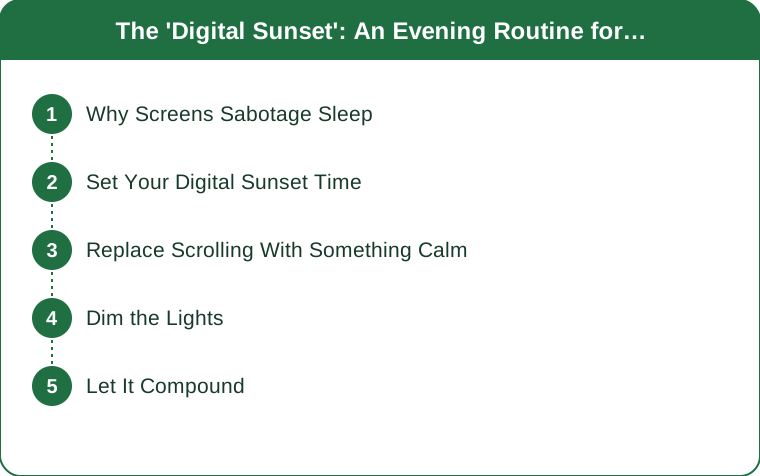
Why Do Screens Make It Harder to Fall Asleep?
Two mechanisms, and they’re worth separating because the fixes are different.
The light problem. Melatonin — the hormone that signals sleepiness — is suppressed by light exposure in the evening, and the shorter blue wavelengths that screens emit heavily are particularly effective at it. The result is that your body’s internal clock reads “still daytime” and pushes the whole sleep window later.
The stimulation problem. This one gets less attention and is probably the bigger factor for most people. Social feeds, news, messages, and cliffhanger episodes are all engineered to hold attention. A mind actively engaged at 11 p.m. isn’t a mind winding down, regardless of what wavelength the screen is putting out.
That distinction matters because it explains why night-shift mode alone often doesn’t help much. Warming the color temperature addresses the light half and leaves the stimulation half completely intact — you’re still reading an argument in a comment section, just in amber.
The practical implication: the boundary has to be about putting the device away, not about adjusting its settings.
How Do You Set Your Digital Sunset Time?
Pick a clock time and treat it as fixed. That’s the whole method, and the fixedness is what makes it work.
How to choose it:
- Work backward from your target bedtime by 30–60 minutes
- If 60 minutes feels impossible, start with 20. A boundary you keep beats an ideal one you don’t
- Use the same time on weekends, or within an hour of it. Consistency is what shifts a body clock
What makes it hold:
- Set an alarm labeled “sunset.” The decision gets made once, in advance, rather than every night at the moment you least want to make it
- Charge the phone in another room. This single change does more than any app or setting, because it converts a decision into a distance
- Get a real alarm clock, if the phone-by-the-bed habit is the reason it’s there
- Tell whoever needs to know. “I’m off my phone after 9:30” prevents the late text that undoes it
Treat it as a boundary rather than a suggestion. The nights it’s easiest to skip — the tired ones, the stressed ones — are the nights it does the most work.

What Should You Do Instead?
Something calm enough to be restful and engaging enough that you don’t just reach for the phone again. Pick one or two and repeat them — repetition is what turns the activity into a sleep cue.
- Read a physical book. The most reliable replacement. Fiction tends to work better than anything work-adjacent
- Stretch or do gentle mobility. Ten minutes, low effort, no goal
- Journal or make tomorrow’s list. Particularly useful if your mind races at bedtime — writing the worry down often stops the looping
- Take a warm shower or bath. The subsequent drop in body temperature is itself a sleep signal
- Do something with your hands. Knitting, a puzzle, tidying one surface. Occupied hands and a quiet mind
- Slow breathing. Four counts in, six counts out, for two minutes. Longer exhales help settle the nervous system
Over a couple of weeks, the routine itself becomes the cue. Your brain starts reading “book plus dim lamp” as the beginning of sleep, which is exactly the association scrolling had been building against.
5 Mistakes Everyone Makes
- Relying on night mode instead of stopping. It addresses the light and does nothing about the stimulation, which is usually the bigger half.
- Keeping the phone on the nightstand. Proximity means a 3 a.m. check, and one check can cost an hour. Charge it in another room.
- Swapping the phone for a laptop or TV. Same light, same stimulation, larger screen. The boundary is about screens generally, not about the phone specifically.
- Setting a two-hour sunset on day one. Ambitious boundaries collapse in about four days. Start at 20–30 minutes and extend once it’s holding.
- Giving up after three bad nights. Body clocks shift over one to two weeks, not overnight. The first few nights often feel restless precisely because you notice the boredom you’d been covering up.
The fifth one ends most attempts, which is a shame, because the first difficult week is the mechanism working rather than failing.
Why Do the Lights Matter Too?
Because your screen isn’t the only light source telling your brain it’s still daytime.
Bright overhead lighting in the evening does the same job as a screen, quietly. Dimming the lights an hour before bed reinforces the signal you’re trying to send, and it costs nothing.
- Switch off overheads and use lamps at eye level or lower
- Choose warm bulbs (2700K or below) for evening rooms
- Keep the bathroom dim during your wind-down — bright bathroom light right before bed undoes a lot of good work
- Get morning light, ideally outdoors within an hour of waking. The morning end of the cycle anchors the evening end
The morning point is the one people skip and it may be the most effective single item here. Body clocks are set by the contrast between bright mornings and dim evenings, not by evenings alone.
Comfortable clothes help the ritual too — changing into something soft at your sunset time is a small physical cue that the day is closing.
When to talk to a professional: if you regularly can’t fall asleep within about 30 minutes, wake repeatedly through the night, snore heavily or gasp in your sleep, or feel exhausted despite adequate hours, that’s worth raising with a doctor. Insomnia and sleep apnea respond to treatment, and neither is a routine problem.
FAQ
How long before bed should I stop looking at screens?
Thirty to sixty minutes is the common recommendation and it’s a reasonable target. If that’s not realistic, twenty minutes done consistently beats sixty minutes attempted twice a week.
Do blue light glasses work?
They may reduce the light exposure somewhat, but they don’t address the stimulation half at all — and for most people that’s the larger factor. They’re a supplement to a digital sunset, not a substitute for one.
What if I use my phone to read or listen to something calming?
Audio is generally fine, since there’s no light and little visual engagement. Reading on the phone is riskier mainly because the notifications and the pull toward other apps are one tap away — a dedicated e-reader or a physical book removes that.
TL;DR:
- Two separate problems: evening light suppresses melatonin, and engaging content keeps you alert
- Night mode only addresses the light half, which is usually the smaller one
- Pick a fixed time 30–60 minutes before bed and set an alarm for it
- Charge the phone in another room — distance beats willpower
- Replace it with one repeatable calm activity so it becomes a sleep cue
- Dim the lights in the evening and get bright light in the morning
- Give it one to two weeks; the first few nights feeling restless is normal
Better sleep often starts with one boundary. Set the sunset, put the phone in another room, dim the lamps, and pick something calm to fill the gap — then hold it for two weeks and let your body clock catch up.
Keep Reading
This article is for general informational and styling purposes only. Fit, sizing, and product availability may vary.