The Complete Guide to Rebuilding Your Rituals After a Move
Quick Answer: Habits are attached to environmental cues — a specific chair, the light at a specific window, the route past a specific shop. A move removes every cue simultaneously, which is why routines that survived years of stress can collapse in a week. Rebuilding works best in a specific order: sleep and morning anchors first, then the physical setup that makes each ritual obvious, then the routes and third places, and only then the optional practices. Trying to restore everything at once is the most common mistake.
Expect six to eight weeks for a full rebuild, and design for the new space rather than replicating the old one.

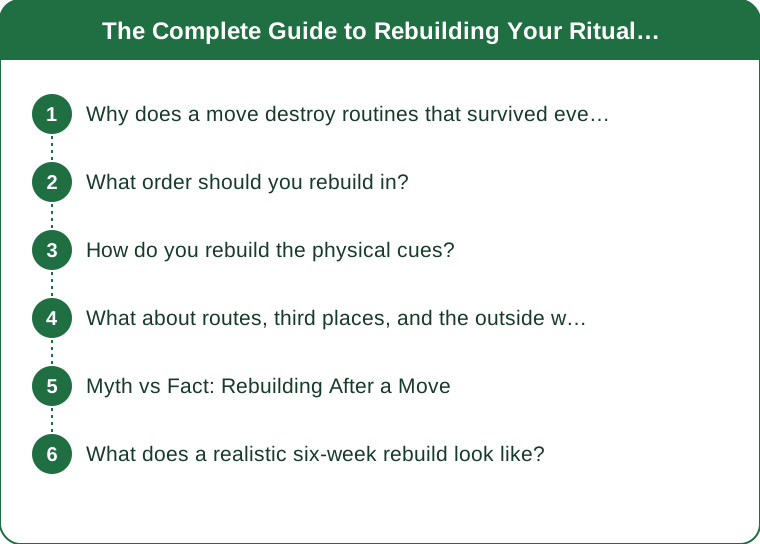
Why does a move destroy routines that survived everything else?
Because a habit is not stored purely in your head. A large part of it lives in the environment.
Behavioral research on habit formation consistently points to context as a central mechanism. A habit is a learned association between a cue and a behavior, and the cue is very often environmental — the sight of the kettle, the specific chair, the corner you turn on your walk, the light hitting a particular spot at a particular hour.
This is why habits feel automatic in a familiar space. You are not deciding to make coffee and then sit in the chair; the environment is prompting a sequence you no longer have to think about.
A move deletes every one of those cues at the same moment. The behavior is still available to you and the prompt is gone, which means every action that used to be automatic now requires a decision.
The cognitive load is the real problem. In a new home, you are already making hundreds of small decisions daily — where things go, which drawer, which route, which shop. Adding six routines that now require conscious initiation is more than most people have capacity for, and the routines are what gets dropped.
This is also why the collapse feels disproportionate. Someone who maintained a morning practice through a demanding job, illness, and a difficult year loses it three weeks after moving, and concludes something is wrong with their discipline. Nothing is wrong with their discipline. Their cues were deleted.
The useful reframe: you are not restarting failed habits. You are rebuilding an environment.
What order should you rebuild in?
Sleep first, then morning, then movement, then everything else. The order matters more than the speed.
Sleep is first because everything else depends on it. A new bedroom means unfamiliar light, unfamiliar sound, a different temperature profile, and often a different bed position. Sleep quality commonly degrades for two to three weeks after a move, and every other rebuild is harder while it does.
Practically: get blackout coverage sorted in week one even if it is temporary. Identify the noise sources and address them. Fix the wake time before anything else, because a fixed wake time is the anchor that every morning ritual attaches to.
Morning is second because it is the most controllable part of the day. In a new place, the rest of the day is chaos — new commute, new logistics, new everything. The first hour after waking is the one segment you can fully determine.
Rebuild one morning element, not the whole sequence. If you used to do coffee, journaling, and stretching, pick coffee in a specific spot and get that solid before adding anything.
Movement is third, because it needs a route or a venue, and those take time to find. A walk from a new front door requires discovering where walking is actually pleasant, which is a week or two of exploration.
Everything else is fourth. Evening rituals, weekly practices, hobbies, social routines. These are genuinely optional during a rebuild, and treating them as optional is what makes the first three succeed.
The common failure is attempting all four tiers in week one, achieving none of them, and concluding the move ruined everything.
How do you rebuild the physical cues?
By designing them deliberately, which is the one advantage a move gives you.
In your old place, the cues accumulated by accident over years. In a new place, you get to place them on purpose, and this is genuinely the best opportunity you will have.
Give each ritual a dedicated location, and make it visible. The reading chair with the book already on it. The mat left out rather than rolled away. The kettle and the mug positioned together. Visible objects are the cue — a yoga mat in a cupboard is not a prompt for anything.
Attach new rituals to fixed events rather than to times. After the kettle boils. When you close the laptop. Before you unlock the front door in the evening. Fixed events survive a changing schedule; clock times do not, especially while a new routine is still forming.
Use the light. Notice which room gets morning light in the new place and put the morning ritual there, even if that is a different room than before. Light is one of the strongest natural cues available and it costs nothing to build around.
Set up the ritual space before you finish unpacking everything else. This feels wrong — surely you unpack the kitchen first — and it is the reason so many rituals never return. A corner set up on day three becomes a habit by week two. A corner set up in month two competes with eight weeks of not doing it.
Do not replicate the old arrangement. The old setup was optimized for a different space. Copying it into a place with different light, different dimensions, and different acoustics usually produces something that does not work and feels vaguely disappointing.

What about routes, third places, and the outside world?
This is the slowest tier and the one people neglect, and it carries more than they expect.
A surprising share of your old routine lived outside your home. The walking route with the good stretch by the park. The coffee shop where you did the Saturday thing. The gym you knew the layout of. The shop you passed on the way home.
These are genuinely hard to replace because they cannot be decided — they have to be discovered.
Give yourself explicit exploration time in the first month. Walk in a different direction each time rather than settling on the first acceptable route. The best route from a new front door is rarely the first one you find, and settling early means living with a mediocre one for years.
Third places take longer than you think and matter more than you think. A cafe, a library, a park bench, a pool — somewhere that is neither home nor work. People who establish one within the first couple of months settle noticeably faster.
Re-anchor the commute-adjacent rituals deliberately. If you used to listen to something on a specific stretch of a specific journey, that journey no longer exists. Choosing what the new equivalent is, rather than waiting for one to emerge, saves weeks.
Expect the first few attempts to feel wrong. A new coffee shop is not your coffee shop. It becomes yours after roughly five or six visits, which means the honest instruction is to go back to a merely acceptable place several times rather than continuing to search for a perfect one.
This tier is where the sense of being settled actually comes from. The inside of your home can be arranged in a fortnight; the outside takes a season.
Myth vs Fact: Rebuilding After a Move
Myth: If a routine mattered, it would survive a move. Fact: Habit strength and environmental dependence are different things. Deeply established habits are often more environmentally dependent, not less, because they became automatic in a specific context.
Myth: You should restore your old routine exactly. Fact: The old routine was shaped by the old space. Copying it into a place with different light and layout usually produces something that does not fit. A move is a rare chance to redesign rather than restore.
Myth: The disruption lasts a couple of weeks. Fact: Six to eight weeks is a more realistic timeline for a full rebuild, and the outside-the-home tier takes longer. Expecting two weeks and taking eight feels like failure; expecting eight and taking six feels like success.
Myth: Get fully unpacked first, then rebuild routines. Fact: Unpacking expands to fill available time. Setting up one ritual space early, before the boxes are done, is what determines whether that ritual returns at all.
Myth: Motivation is what is missing. Fact: Cues are what is missing. People experience the absence of cues as an absence of motivation, which leads them to try to solve it with willpower — the least effective available tool.
Myth: A bigger or nicer place makes routines easier. Fact: More space often means routines spread out and lose their cue density. A small space where everything is visible can support habits better than a large one where the mat is in a different room.
What does a realistic six-week rebuild look like?
A staged plan that assumes limited capacity, because capacity is genuinely limited during a move.
Week 1 — sleep only. Fix the wake time. Sort light and noise in the bedroom even if the solution is temporary. Do not attempt any other ritual. This week is deliberately minimal because everything else is consuming you.
Week 2 — one morning anchor. Pick the single most important morning element and give it a dedicated spot. Coffee in a specific chair, ten minutes of something, whatever it is. One thing. Set the space up physically before you need it.
Week 3 — add movement, in exploration mode. Walk from the new door in a different direction every day. You are not establishing a route yet; you are finding candidates. Any walk counts.
Week 4 — add the second morning element and settle a route. By now the first morning anchor should be running with less deliberation. Add one more to it. Pick the best of the walking routes and start repeating it — repetition is what makes it a route rather than a walk.
Week 5 — evening ritual and third place. Establish one evening element, ideally attached to a fixed event like closing the laptop or eating. Start visiting one candidate third place repeatedly.
Week 6 — review and add one optional thing. Look at what has actually stuck versus what you have been forcing. Drop anything that has not taken, and add one of the optional practices you have been missing.
Two notes on this timeline. First, it is deliberately slower than you will want it to be. The temptation at week two, when the boxes are gone and life looks normal, is to restore everything at once. That is the point where most rebuilds fail.
Second, moves in late summer and early autumn have an advantage worth using. The returning-structure season does some of the work for you — school and work schedules reassert themselves, which supplies external anchors you would otherwise have to create. A move in this window can be rebuilt faster than one in, say, late spring, when everything is loosening rather than tightening. If you have moved recently, the next few weeks are the easiest time of year to rebuild.
And one final reframe worth holding onto: a routine that has to be consciously rebuilt is a routine you get to examine. Some of what you had was genuinely valuable, and some of it was just old. The rebuild is the only chance you get to tell the difference.
TL;DR:
- Habits are cued by the environment, and a move deletes every cue at once — the collapse is about context, not discipline.
- Rebuild in order: sleep, then one morning anchor, then movement, then everything else. Attempting all of it at once is the standard failure.
- Place cues deliberately and visibly, attach rituals to fixed events rather than clock times, and design for the new space instead of copying the old one.
- Routes and third places take longest and matter most for feeling settled; go back to a merely acceptable place five or six times rather than searching for a perfect one.
Expect six to eight weeks. Set up one ritual corner before the boxes are finished — that single decision determines more than any amount of willpower afterward.
Keep Reading
This article is for general informational and styling purposes only. Fit, sizing, and product availability may vary.