The Complete Guide to Building Rituals That Survive a Bad Month, Not Just a Good Week
Quick Answer: Rituals that survive a genuinely bad month share three traits — they take under five minutes, they don’t require a specific mood or energy level to start, and they have a built-in ‘minimum version’ for the worst days — while most ritual advice is quietly written for someone who’s already doing fine, which is exactly when a ritual is least needed.
Anyone can keep a ritual during an easy week. The real test, and the real value, is whether it survives a hard one — this is a full guide to building for that instead.

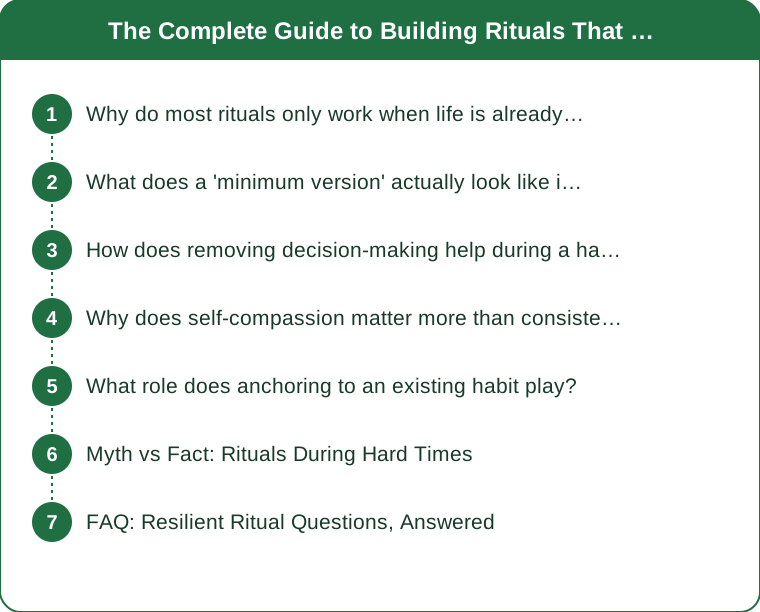
Why do most rituals only work when life is already going well?
Most ritual advice — the 20-minute morning routine, the elaborate evening wind-down — assumes a baseline of stability that simply isn’t there during a bad month. A ritual built for a calm, well-slept version of you will get dropped the first time you’re exhausted, overwhelmed, or dealing with a crisis, because it was never designed to flex. The irony is that rituals matter most exactly when things are hardest, which is also when the elaborate version becomes impossible. A resilient ritual has to be built from the start with the worst version of your week in mind, not the best one. That means designing backwards from ‘what’s the smallest version of this I could still do on the worst day’ rather than forwards from ‘what would be ideal if everything went right.’ This single shift in design philosophy is the difference between a ritual that survives October and one that only ever existed in September.
What does a ‘minimum version’ actually look like in practice?
For almost any ritual, there’s a five-minute or under version that preserves the core of it. A 20-minute morning routine might have a 90-second minimum version — just the first step, done alone, with nothing else attached. A nightly journaling practice might shrink to writing a single word. The key is deciding on this minimum version in advance, before the bad month arrives, rather than trying to improvise it in the moment when willpower and clarity are both already low. Write the minimum version down somewhere visible. On good days, do the full ritual. On the worst days, doing only the minimum version still counts as keeping the ritual alive — it’s not a failure or a lesser attempt, it’s the version built specifically for that day. This reframing matters enormously, because the alternative — treating anything less than the full ritual as not counting — is exactly what causes people to quit entirely rather than scale down.
How does removing decision-making help during a hard month?
During a bad month, decision-making capacity is often the first thing to go — you’re already spending it on the actual crisis. A ritual that requires deciding when, how, or whether to do it each day adds a cost that a fixed, automatic one doesn’t. This is why time-and-place-based rituals (‘right after I make coffee, before I check my phone’) tend to survive better than mood-based ones (‘when I feel like it’ or ‘when I have energy’). The cue removes the decision entirely — you’re not asking whether to do it, you’re just doing the thing that always follows the cue. During a good week this barely matters, because you have surplus decision-making capacity to spare. During a bad month, it’s often the single biggest factor in whether the ritual survives, because every removed decision is one less thing competing for already-depleted mental resources.

Why does self-compassion matter more than consistency tracking here?
Streak-based tracking (day 47! don’t break the chain!) works well during stable periods but tends to backfire hard during a bad month — missing a day feels like the whole effort is ruined, which often leads to abandoning the ritual entirely rather than just resuming the next day. A more resilient framing treats each day as independent: missing Tuesday has zero bearing on whether Wednesday counts. This isn’t about lowering standards — it’s about designing a system that doesn’t punish the exact weeks when the ritual is hardest to maintain and most needed. Self-compassion research in habit formation consistently shows that people who treat a missed day neutrally return to the habit faster than those who treat it as a failure, which compounds into a meaningful difference over a genuinely difficult month.
What role does anchoring to an existing habit play?
New rituals introduced during a bad month have a much lower survival rate than ones already anchored to an existing, unshakeable habit — brushing teeth, making coffee, getting into bed. Attaching the ritual to something you were always going to do anyway means it doesn’t need its own independent motivation to survive. This is the core idea behind habit stacking, and it becomes especially valuable during hard periods, because the anchor habit (coffee, teeth-brushing) tends to survive a bad month even when everything else falls apart. If the ritual only exists as its own standalone item on a to-do list, it’s competing for attention with everything else that’s currently overwhelming. If it’s stitched onto something automatic, it inherits that automaticity.
Myth vs Fact: Rituals During Hard Times
Myth: if you can’t do the full ritual, there’s no point doing part of it. Fact: a five-minute minimum version done consistently through a hard month preserves the habit far better than an all-or-nothing approach that collapses at the first missed day.
Myth: rituals should be paused during genuinely difficult periods to reduce pressure. Fact: for most people, a scaled-down ritual actually reduces overall stress by providing one small, reliable anchor point in an otherwise chaotic stretch — the goal is scaling down, not stopping entirely.
Myth: a broken streak means starting over from zero, mentally and practically. Fact: treating each day independently, rather than as part of an unbroken chain, leads to faster and more durable return to the habit after a missed day.
FAQ: Resilient Ritual Questions, Answered
How do you know if a ritual is genuinely too demanding for a bad month?
If it requires a specific mood, more than about five minutes at minimum, or a decision each time whether to do it, it’s likely to fail during a hard stretch — those are the three warning signs worth designing around in advance.
Should the minimum version be decided in the moment or planned ahead?
Plan it ahead, ideally when you’re not in a hard period — decision-making during the crisis itself is exactly the resource that’s already depleted, so improvising a minimum version in the moment often fails.
Is it normal for a ritual to look completely different during a bad month versus a good one?
Yes, and that’s actually the sign of a well-designed resilient ritual — the ability to shrink to its minimum version without disappearing entirely is the whole point of building it this way from the start.
TL;DR:
- Most ritual advice assumes a stable, well-rested life, so it quietly fails during the exact weeks a ritual matters most
- Deciding a five-minute ‘minimum version’ in advance keeps the ritual alive on the worst days
- Fixed cues (time or place) remove decision-making, which is the resource hit hardest during a bad month
- Treating each day independently, rather than tracking an unbroken streak, leads to faster recovery after a missed day
- Anchoring a new ritual to an already-automatic habit gives it a much higher survival rate during hard periods
A ritual that only works when life is calm was never really tested — building the minimum version now, before you need it, is what actually makes it durable.
Keep Reading
This article is for general informational and styling purposes only. Fit, sizing, and product availability may vary.