How to Build a Morning Ritual That Actually Survives a Genuinely Bad Week
Quick Answer: A morning ritual that only works on easy days isn’t really a ritual — it’s a best-case routine. The rituals that survive genuinely bad weeks are built with a deliberately scaled-down minimum version from the start (a 2-minute version alongside the 20-minute ideal), so that a bad day has a floor to fall back to instead of an all-or-nothing collapse.
A copied morning routine works beautifully for the first ten days. Then a bad week hits, and the whole thing quietly disappears — often for good.

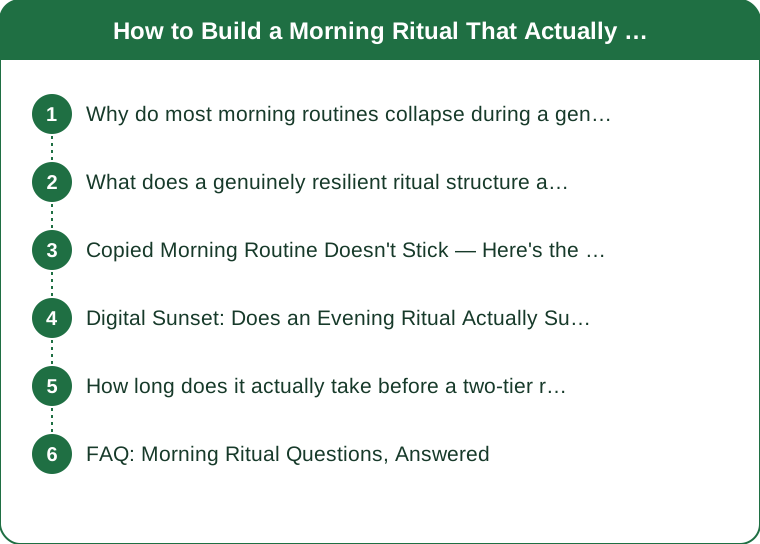
Why do most morning routines collapse during a genuinely hard week specifically?
Most morning routines are designed around an ideal version — a full 20-30 minute sequence — with no smaller version built in for a day when there’s genuinely no time or capacity for that. When a hard week hits (poor sleep, a stressful event, illness, travel), the all-or-nothing structure means people skip the whole thing entirely rather than doing a smaller version, and that skip often becomes the moment the habit quietly dies rather than pauses.
This is a design problem, not a discipline problem. A routine built with only one version — the full one — has no fallback position, which means any disruption to capacity or time becomes a disruption to the entire habit rather than a temporary scaling-down of it.
What does a genuinely resilient ritual structure actually look like?
Build two versions from the start: a full version (10-20 minutes) and a floor version (60-120 seconds) that captures the core intention in miniature. If the full ritual is journaling, stretching, and quiet coffee time, the floor version might be just three lines in a journal and one minute of stillness — genuinely small enough to complete even on the worst mornings. The floor version isn’t a lesser ritual; it’s the same ritual scaled to match a bad day’s actual capacity.
The key psychological benefit is continuity — doing the 90-second floor version on a terrible day keeps the habit technically unbroken, which makes it far easier to return to the full version once capacity comes back, compared to a multi-day or multi-week gap that requires restarting the habit from scratch.
Copied Morning Routine Doesn’t Stick — Here’s the Actual Reason
A routine copied wholesale from someone else’s life is built around their constraints, energy levels, and priorities, not yours. A five-step morning routine that works for someone without kids, with a flexible schedule, and with a naturally early chronotype often has almost nothing in common with a workable version for someone commuting at 7am with young children. The mismatch isn’t a personal failing — it’s a structural fit problem, and building a ritual from your own actual constraints (not an influencer’s) is what makes it durable in the first place.

Digital Sunset: Does an Evening Ritual Actually Support the Morning One?
A consistent wind-down before bed (dimming lights, stopping screens 30-60 minutes before sleep, a brief reading or stretching habit) directly supports next-morning ritual success, since sleep quality is one of the biggest predictors of whether someone has the capacity to follow through on a morning routine at all. Treating the evening and morning as one connected system, rather than two separate habits, addresses a root cause that morning-only advice usually misses entirely.
How long does it actually take before a two-tier ritual (full + floor version) feels automatic?
Most habit research points to a wide range — anywhere from 3 to 10 weeks, depending on complexity and consistency, with the floor version typically becoming automatic faster than the full version since it requires less decision-making and time investment. Tracking completion of either version (not just the full one) on a simple calendar or app gives a more honest, less discouraging picture of actual consistency than tracking the full version alone.
FAQ: Morning Ritual Questions, Answered
Should the floor version ever become the permanent version?
If the floor version consistently feels sufficient and sustainable over months, that’s a legitimate outcome, not a failure — the goal is a ritual that actually gets done, not adherence to a specific time length.
What’s a good floor-version ritual for someone who has almost no consistent morning time?
Something under 90 seconds that requires no setup — three deep breaths, one line in a note app, or a single stretch — is realistic even on the most compressed mornings and still provides the continuity benefit.
Does having a floor version make people less likely to do the full version?
Generally the opposite — knowing a floor version exists removes the all-or-nothing pressure that causes people to skip entirely, which in practice supports doing the full version more often, not less.
TL;DR:
- Routines with only a full version tend to collapse entirely during genuinely hard weeks
- Building a 60-120 second floor version alongside the full ritual keeps the habit technically unbroken
- Copied routines often fail because they’re built around someone else’s constraints, not yours
- A consistent evening wind-down materially supports next-morning ritual success
A ritual that only works on good days isn’t really a system — the floor version is what actually makes it one.
Keep Reading
This article is for general informational and styling purposes only. Fit, sizing, and product availability may vary.