How to Build a Self-Care Routine That Actually Sticks
Monday: journal, stretch, meditate, walk, no phone after nine. Tuesday: four of five. Wednesday: two. By Thursday the whole thing is a list you’re avoiding. If that arc feels familiar, it isn’t a discipline problem — it’s a design problem, and design problems are fixable.
Quick Answer: Self-care routines stick when you start with one habit under five minutes, attach it to something you already do every day, and accept a “most days” standard instead of a perfect one. Research on habit formation suggests it takes roughly two months for a new behavior to feel automatic, with wide variation between people — which means the routine you can sustain for eight weeks beats the ambitious one you abandon in eight days.

Why Do Most Self-Care Routines Collapse by Thursday?
Because they’re designed for your best day and then run on your ordinary ones.
A five-part morning ritual is genuinely doable on a Sunday with nowhere to be. On a Tuesday with an early meeting and a bad night’s sleep, it’s not a routine — it’s a list of things you’re now failing. And the failure isn’t neutral: missing three of five items feels worse than never having planned them, so the whole structure gets quietly abandoned.
Three specific design flaws account for most collapses:
- Too big at the start. Ambition is highest on day one and lowest on day nine. Build for day nine.
- No trigger. A habit with no cue depends on you remembering, and remembering is the first thing to go on a busy day.
- All-or-nothing framing. One missed day becomes “I’ve broken it,” which becomes stopping entirely.
None of these are about willpower. They’re about how the routine was built.

How Small Should You Actually Start?
Smaller than feels worth doing. That’s not a figure of speech — it’s the mechanism.
Start with one habit that takes under five minutes. One. Five minutes of stretching, a ten-minute walk, one cup of tea you actually sit down for. The goal in the first two weeks isn’t the benefit of the habit; it’s proving to yourself that the habit happens.
The reason this works is that a two-minute version survives the days a thirty-minute version doesn’t. On a chaotic Tuesday, “stretch for ninety seconds” still happens. And a habit that survives chaotic Tuesdays is a habit you actually have.
Scale up only after two consistent weeks, and only by a few minutes at a time. Most people who go from five minutes to twenty in one jump are back to zero within a week.
What’s the Fastest Way to Remember a New Habit?
Attach it to a habit you already have. This is habit stacking, and it removes the hardest part — remembering — entirely.
The formula: after [existing habit], I will [new habit].
- After I brush my teeth, I’ll stretch for two minutes
- After I pour my morning coffee, I’ll write three lines in a journal
- After I close my laptop for the day, I’ll walk around the block
- After I get into bed, I’ll do four slow breaths
The existing habit becomes the alarm clock. You’re not building a new reminder system; you’re borrowing one that’s already reliable.
Pick anchors that happen at the same point every day. “After lunch” is weaker than “after I put my plate in the sink,” because the second one is a specific physical moment.
5 Mistakes Everyone Makes
- Starting five habits at once. Each new habit competes for the same finite attention. One at a time, and the second one only after the first is automatic.
- Choosing things you don’t enjoy. A routine built on activities you dread is just a chore list with better branding. If you hate journaling, don’t journal.
- Scheduling it for a time you don’t have. A 6 a.m. routine when you’re not a morning person fails on the merits, not on your character.
- Treating a missed day as a broken streak. Missing once has no measurable effect on habit formation. Missing once and then quitting does all the damage.
- Measuring by intensity rather than frequency. A ten-minute walk five days a week beats a ninety-minute spa session once a month, and it isn’t close.
The fourth one is the quiet killer, because it’s the mistake that turns a small stumble into a full stop.
What Does a Realistic Starter Routine Look Like?
Thin on purpose. Add later.
- Morning (3–5 minutes): stretch, or sit with your coffee without your phone
- Midday (10 minutes): a real walk outside, or a genuine pause away from your desk
- Evening (5 minutes): a wind-down — reading a few pages, four slow breaths, a warm shower
That’s under twenty minutes across a whole day, and it’s more than most people sustain. Adjust freely — the best routine is the one that fits your actual life rather than someone else’s highlight reel.
If movement is part of yours, remove the friction around it. Laying out clothes the night before is a small thing that removes a real decision, and having a high waist legging you’re comfortable in makes a morning stretch or an evening walk a two-minute decision instead of a five-minute one.

Why Does Consistency Beat Intensity?
Because the effect of self-care is cumulative, not acute.
A single long session feels good for an afternoon. Ten minutes done most days changes your baseline — sleep, stress tolerance, energy — over weeks. The magic isn’t in any one act; it’s in the repetition, and repetition only comes from a routine light enough to repeat.
Aim for “most days,” not every day. Five out of seven is a real, sustainable routine. Seven out of seven is a standard that breaks the first time life doesn’t cooperate.
A note on scope: routines like these support general wellbeing, and they aren’t a substitute for care. If you’re dealing with persistent low mood, anxiety that interferes with daily life, ongoing sleep problems, or exhaustion that doesn’t lift with rest, that’s worth raising with a doctor or a mental health professional — those respond to treatment, not to better scheduling.
FAQ
How long does it take for a self-care routine to feel automatic?
Research on habit formation points to a median of around two months, but the range is wide — some habits settle in three weeks and others take six months. Simple, short, well-anchored habits sit at the fast end.
What if I miss several days in a row?
Restart at the smallest possible version rather than trying to make up ground. Two minutes tomorrow rebuilds the pattern; a compensating hour-long session usually just confirms that the routine is exhausting.
How do I fit a routine in when I genuinely have no time?
Shrink it until it fits — sixty seconds counts. A one-minute habit that happens daily is worth more than a thirty-minute one that happens when your schedule allows, which is to say rarely.
TL;DR:
- Start with one habit under five minutes, not a full routine
- Anchor it to a specific existing habit: “after I brush my teeth, I’ll…”
- Choose things you actually enjoy — dread is not a sustainable input
- Aim for most days, not every day; a missed day breaks nothing unless you quit
- Scale up only after two consistent weeks, a few minutes at a time
- Frequency beats intensity; ten minutes most days outperforms a monthly reset
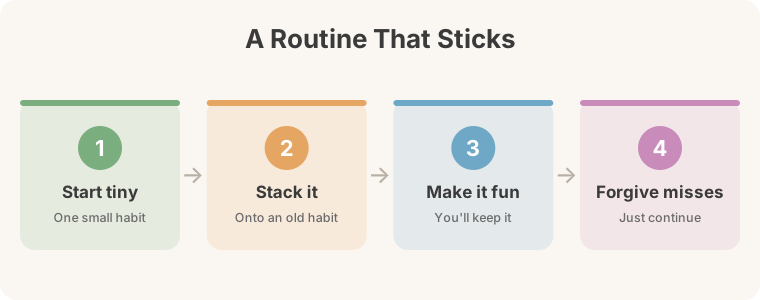
Build a self-care routine that sticks by starting absurdly small, attaching it to what you already do, keeping it enjoyable, and forgiving the days you miss. Start tiny, stay kind, keep going — that really is the whole secret.
Keep Reading
This article is for general informational and styling purposes only. Fit, sizing, and product availability may vary.